Thus spoke Ambedkar Last Message to the people
“Whatever I have done, I have been able to do after passing through crushing miseries and endless struggle all my life and fighting with my opponents. With great difficulty I have brought this caravan where it is seen today. Let the caravan march on despite the hurdles that may come in its way. If my […]
Thus spoke Ambedkar Last Message to the people
Citizens’ Vigilance and Monitoring Committee (CVMC): List of questions on the implementation status of The Scheduled Castes and the Scheduled Tribes (Prevention of Atrocities) Act, that your MPs could ask in the parliament’s winter session from 4 to 22 December 2023. Kindly meet with the MPs in your constituencies with the request that they raise the attached questions.
List of questions prepared at the First National Roundtable on the implementation status of The Scheduled Castes and the Scheduled Tribes (Prevention of Atrocities) Act on 14 October 2023 at New Delhi.
1 Section 4 : The government should take action on those officers who don’t implement the provisions of this act including refusal to register the case. Officers implementing the Act effectively must be rewarded.
1.1 How many exclusive special public prosecutors and special public prosecutors have a conviction rate more than 50%. How many have been removed for low convictions?
1.2 How many investigation officers have a conviction rate more than 50%. How many have been removed for low convictions?
1.3 Which are the officials (investigation officers, exclusive special public prosecutors, and public prosecutors) identified by the standing committee (vide orders of the Supreme Court of India in the State of Gujarat vs Kishanbhai etc. [Criminal Appeal No. 1485 of 2008] dated 7 January 2014). How many have been removed?
1.4 How many states have less than 10% conviction rate? How many officials have been removed for underperformance?
1.5 How many cases have been acquitted due to ‘witnesses turned hostile’? How many DSPs and/or investigation officers have been charged u/s 4 for dereliction of duty for not providing adequate protection u/s 15A(9)?
1.6 Most states have low single digit conviction rates despite cases being investigated by DSPs, prosecuted by Special Public Prosecutors (of seniority of seven years or more), reviewed by district magistrates, and monitored by the special courts. What is the ministry’s action plan to improve the conviction rate?
1.7 Using NCRB data from 2019 to 2021, the citizens’ vigilance and monitoring committee (CVMC) report on the implementation of the Scheduled Castes and the Scheduled Tribes (Prevention of Atrocities) Act, 1989 reveals that only 3% of the acquitted cases are appealed. Will the ministry issue an advisory to automatically appeal all cases of acquittal, and disciplinary action be taken (including removal from IO/SPP under this Act) for all officials identified by the standing committee (vide orders of the Supreme Court of India in the State of Gujarat vs Kishanbhai etc. [Criminal Appeal No. 1485 of 2008] dated 7 January 2014)?
2 Special courts established under the Act should not be given other cases.
2.1 How many special courts have more than 50 pending cases?
2.2 How many exclusive special courts have more than 50 pending cases?
2.3 Give state state–wise, year–wise number of pending cases in court.
2.4 What is the criteria for declaring exclusive special courts?
2.5 How many exclusive special courts have been declared, state–wise.
2.6 How many of the exclusive special courts are in identified (atrocity prone) areas?
2.7 How many of these exclusive special courts are being supported by the union government?
2.8 What is the criteria for union government financial support to the exclusive special courts?
2.9 What measures have been taken by the union government to bring down the pendency of the cases, which have almost doubled during the last five years, resulting in delayed relief of about 3000 crores to the victims and increasing the chances of acquittal?
3 Under rehabilitation, the victims must be provided with a government job.
3.1 Using NCRB data from 2017 to 2021, the citizens’ vigilance and monitoring committee (CVMC) report on the implementation of the Scheduled Castes and the Scheduled Tribes (Prevention of Atrocities) Act, 1989 estimates that a minimum of 27,724 victims and their families should have been given 27,724 pensions, 27,724 government jobs, 27,724 houses with land, 27,724 households with farming land, and 27,724 children (one child per family) should be enrolled on their way to graduation. How many have been given so far? What measures are being taken by the ministry to ensure that the socioeconomic rehabilitation is being done on time, and in full?
3.2 Analysing the information in the Union Report u/s 21(4) and the state annual reports u/r 18 for the calendar year, the citizens’ vigilance and monitoring committee (CVMC) report on the implementation of the Scheduled Castes and the Scheduled Tribes (Prevention of Atrocities) Act, 1989 concludes that the daily maintenance expense at one day’s daily wage for the witnesses, victims, and their attendants is not being paid. Does the union government have any data on this? And if so, how many states have paid the minimum wages as maintenance expenses u/r 11. If not, what is the plan of the MoSJ&E to collect the data and ensure that it is paid?
3.3 Only 6 of the eligible 5,734 victims received the Dr Ambedkar Foundation instant monetary relief in 2020. How does the MoSJ&E propose to ensure better coverage?
3.4 How many persons received the instant monetary relief from the Dr Ambedkar Foundation for the years 2021 and 2022. Please give a list yearh–wise, state–wise, and the amount disbursed.
4 Under the Prevention of Atrocities Act. DySP is empowered to take action if any petition is received from Dalits in atrocity prone zone, that atrocity is likely to be committed. Government should issue circular empowering DySP to take action in this regard.
4.1
5 Group of persons who likely to commit atrocity shall be imposed with collective fine.
5.1 In Manipur the atrocities against the scheduled tribes should attract collective fines u/s16, the leaders should be externed from the district u/s10, and the forfeiture of property u/s7. How has the ministry being following up on these provisions. How many collective fines have been imposed, how many externment orders have been issued, and how many properties have been forfeited? What are the advisories the ministry has issued in this regard?
5.2 How many of the victims and their families have been covered under the Dr Ambedkar Foundation instant monetary relief u/r 15(1)(a), the statutory relief and socioeconomic rehabilitation (pensions, government jobs, houses, and education for children up to graduation) u/r 12(4) thus far? How many are eligible? By when will the coverage be provided?
6 A special Act should be brought in to prevent the killing of inter caste marriage couple.
6.1
7 Sensitisation programme for all officers including judicial officers concerned with implementation of the Act.
7.1
8 Guidelines should be issued regarding appointment of special public prosecutor and identification of atrocity prone areas.
8.1 Only four states have notified the contingency plan u/r 15(1). Has the ministry issued advisories to the other states to gazette notify their contingency plans? If not, what is the ministry’s follow–up action plan to get this rule implemented 7 years after the amendments were notified?
8.2 The ministry’s annual report u/s 21(4) notes that most of the atrocities are committed in 15 states (12 for the scheduled castes and 12 for the scheduled tribes). What is the reason for not gazette notifying the contingency plans?
8.3 Has the MoSJ&E prepared a model contingency plan for the UTs? If so, kindly furnish a copy. If not, by when will it be done?
9 All the state governments, Government of India and political parties should be given the copy of this report.
9.1
10 RTI Act and filing of PIL should be made use for better implementation of the Act.
10.1 The annual reports u/s 21(4) and the state annual reports u/r 18 received by the union government are not being uploaded on to the website of the MoSJ&E. Can the minister assure the house that the state annual reports will be uploaded within a week of receipt (last date 31 March every year), and the union report by July 31 each year.
10.2 The website of the Dr Ambedkar Foundation has been down since February 2023. When will it be up again.
10.3 The Crime in India 2022 report of the National Crime Records Bureau has not yet been released, despite computerisation and faster communication. Can the union minister of home affairs inform the house of the reasons for delay and the date when it will be released? (Ministry of Home Affairs).
11 Creation of awareness. Government shall fund NGOs for the creation of awareness-among the non-SC/ST population also regarding implementation of the Act.
11.1 The annual reports u/s 21(4) and the state annual reports u/r 18 received by the union government do not mention any NGO being supported financially to be run awareness centres or conduct workshops, despite being mandatory u/r 3(ix). The NHRC has also recommended that there be one NGO supported per district, and one women’s NGO be supported per state. Has the ministry issued advisories to get this rule implemented 7 years after the amendments were notified?
Note:
Other than 10.3 all other questions comes under Ministry of Social Justice and Empowerment.
“Cricket is a game where eleven fools play and eleven hundred fools watch”.
George Bernard Shaw once mentioned that “Cricket is a game where eleven fools play and eleven hundred fools watch”. One look at the teams will clear up all your doubts. How the pappati pot bellied Brahmins have injected the caste system. Look at the list of Brahmin Indian cricketers: Sunil Gavaskar, Ravi Shastri, Anil Kumble, […]
“Cricket is a game where eleven fools play and eleven hundred fools watch”.
Telangana Padakosham
*తెలంగాణా పదకోశం: (1466 పదాలు)*
1. తూటు : రంధ్రం
2. ఏతులు : గొప్పలు
3. మలుపు : మూల
4. తాపతాపకు : మాటిమాటికి
5. జల్ది : త్వరగా
6. కొత్తలు : డబ్బులు
7. ఏంచు : లెక్కించు
8. నాదాన : బలహీనం
9. నప్పతట్లోడు: పనికి మాలినవాడు
10. ల్యాగ : ఆవు దూడ
11. గుపాయించు: జొరబడు
12. కూకొ : కూర్చో
13. కూనం : గుర్తు
14. మడిగ : దుకాణం
15. పొట్లం : ప్యాకింగ్
16. బత్తీసలు : అప్పడాలు
17. పతంగి : గాలిపటం
18. సోంచాయించు: ఆలోచించు
19. పయఖాన : టాయిలెట్
20. మోసంబి : బత్తాయి
21. అంగూర్ : ద్రాక్ష
22. కష్కష్ : గసాలు
23. కైంచిపలంగ్ : మడత మంచం
24. చెత్రి : గొడుగు
25. కల్యామాకు : కరివేపాకు
26. మచ్చర్దాన్ : దోమతెర
27. మడుగుబూలు: మురుకులు
28. జమీర్ఖాన్ : భూస్వామి
29. జాగా : స్థలం
30. తండా : చల్లని
31. గర్మి : వేడి
32. వూకె : ఉట్టిగా
33. సిలుం : తుప్పు
34. నియ్యత్ : నిజాయితీ
35. తపాలు : గిన్నె
36. తైదలు : రాగులు
37. పలంగి : మంచము
38. బలంగ్రి : డ్రాయింగ్ రూం
39. సల్ప : నున్నని రాయి
40. దప్పడం : చారు
41. గెదుముట : పరిగెత్తించుట
42. తొక్కు : పచ్చడి
43. కిసా : జేబు
44. సల్ల : మజ్జిగ
45. అర్ర : గది
46. బుడ్డలు : పల్లీలు
47. గడెం : నాగలి
48. గాండ్లు : బండి చక్రాలు
49. కందెన : ఇంధనం
50. ఉప్పిండి : ఉప్మా
51. చిమ్ని : బుగ్గదీపం
52. తపుకు : ప్లేటు
53. ముగ్గ : చాలా
54. కందీలు : లాంతరు
55. బటువు : ఉంగరం
56. బాండ్లి : మూకుడు
57. సలాకి : అట్లకాడ
58. ఈలపీట : కత్తిపీట
59. గనుపట్ల : గడప దగ్గర
60. గుండ్లు : రాళ్ళు
61. సల్వ : చల్లదనం
62. ఏట కూర : మేక మాంసం
63. గాలిపంక : ఫ్యాను
64. షాపలు : చేపలు
65. సౌంర్త పండుగ: పుష్పాలంకరణ
66. కుమ్మరావి : కుండలబట్టి
67. లోట : డబ్బ
68. ఇడుపు : గోడంచు
69. సౌరం : క్షవరం
70. శిబ్బి : తీగల జల్లెడ
71. తూటు : రంధ్రం
72. శిరాపురి : పరమాన్నం
73. తీట : కోపం
74. పటువ : కుండ
75. తలె : పల్లెం
76. పొర్క : చీపురు
77. సపారం : పందిరి
78. సర్కార్ ముల్లు: కంపముల్లు
79. దేవులాడు : వెతుకు
80. వాగు : నది
81. సడాకు : రోడ్డు
82. చిత్పలకాయ: సీతాఫలం
83. ఏమది : ఏమిటి
84. లచ్చమ్మ : లక్ష్మమ్మ
85. రామండెం : రామాయణం
86. తక్కడి : త్రాసు
87. గంటె : చెంచా
88. కాందాని : పరువు
89. బూగ : తూనీగ
90. సందుగు : పెట్టె
91. బిటాయించు: కూర్చోమను
92. జొన్న గటుక: జొన్న గింజల అన్నం
93. కంచె : సరిహద్దు
94. లైయ్ : అతికించే పదార్థం
95. బాపు : నాన్న
96. ఆనతి : అభయం
97. సోలుపు : వరుస
98. పీనోడు : పెండ్లి కొడుకు
99. దురస్తు : బాగుచేయు
100. శిరాలు : మెడ
101. కందీలు : లాంతరు
102. ఆర్సీలు : కళ్ళజోడు
103. మక్కెండ్లు : మొక్కజొన్న
104. సుట్టాలు : బంధువులు
105. మాలస : ఎక్కువ
106. కైకిలి : కూలి
107. కొయ్గూర : గొంగూర
108. కూడు : అన్నం
109. అసంత : దూరంగ
110. సిబ్బి : గుల్ల
111. పావుడ : పార
112. సలమల : వేడిలో మరగడం
113. ఊకో : కాముగా ఉండు
114. జల్దిరా : తొందరగా రా
115. తపుకు : మూత
116. తువ్వాల : చేతి రుమాలు
117. లాగు : నెక్కరు
118. కాయిసు : ఇష్టం
119. బుగులు : భయం
120. ఉర్కుడు : పరుగెత్తుడు
121. శానా : చాల
122. గట్లనే : అలాగే
123. గిట్లాంటి : ఇలాంటి
124. బర్కత్ : లాభం
125. కుసో : కూర్చొండి
126. తర్జుమా : అనువాదం
127. నెరసు : చాలా చిన్నదైన
128. బకాయి : చెల్లించవలసిన మొత్తం
129. తోఫా : కానుక
130. ఇలాక : ప్రాంతం
131. బరాబరి : సరి సమానం
132. ఉసికే : ఇసుక
133. తోముట : రుద్దుట
134. గీరె : గిరక
135. బొంది : శరీరం
136. ఉలికిపడుట : అదిరిపడుట
137. ఈడు : వయసు
138. జోడు : జంట
139. కూడు : అన్నం
140. గోడు : లొల్లి
141. అల్లుట : పురి వేయుట
142. నుల్క : మంచానికి అల్లే తాడు
143. శెల్క : తెల్లభూమి
144. మొల్క : పుట్టిన మొక్క
145. శిల్క : చిలుక
146. పల్కు : మాట్లాడు
147. ఈతల : ఈవల
148. ఆతల : ఆవల
149. తను : అతడు
150. దిడ్డి ధర్వాజ : మరో ద్వారం
151. కొట్టం : పశువుల పాక
152. గూటం : పశువుల కట్టేసే గుంజ
153. పగ్గం : తాడు
154. శాయిపత్తి : తేయాకు
155. పెంక : పెనం
156. సుంకం : పన్ను
157. లెంకు : వెతుకు
158. తొంట చెయ్యి : ఎడమ చెయ్యి
159. తక్కెడు : ముప్పావు కిలో
160. దేవులాడు : వెతుకు
161. నడిమీలకు : మధ్యలకు
162. పుండు కోరుడు : వివాదాస్పదుడు
163. పత్యం : నియమాహారం
164. పాకులాడు : ప్రయత్నించు
165. పగిటీలి : పగటి పూట
166. పొడవూత : పొడవునా
167. పొద్దుగాల : ఉదయం
168. బరిగె : బెత్తం
169. బంజరు : ప్రభుత్వ భూమి
170. దెంకపోవుట : పారిపోవుట
171. నజీబ్ : అదృష్టం
172. మాలేస్క : ఎక్కువ
173. మతులాబ్ : విషయం
174. మనుండంగ : ప్రాణంతో ఉండగ
175. సటుక్కున : తొందరగా
176. సముదాయించుట : నచ్చ జెప్పుట
177. సైలేని : చక్కగా లేని
178. ఇకమతు : ఉపాయం
179. ఎక్క : దీపం
180. ఆలి : పెండ్లం
181. దుత్త : చిన్న మట్టి కుండ
182. ఎళ్ళింది : పోయింది
183. గైండ్ల : వాకిట్ల
184. తలగాయిండ్ల: వాకిలి ముందు
185. అంబలి : జావ
186. దప్పడం : సాంబారు, పప్పుల పులుసు
187. కుడుము : ఇడ్లీ
188. ఎసల : వండులకు ఉపయోగించే కుండ
189. నాలె : నేల
190. ఓరకు : పక్కకు
191. ఒల్లె : చీర
192. తాతిపారం : మెల్లగ
193. ఎరుక : తెలుసు
194. మొరగు : అరచు
195. అంబాడు : చిన్నపిల్లల పాకుడు
196. అర్సుకొనుట: పరామర్శించుట
197. ఊసు : కండ్ల నుండి వచ్చే మలినం
198. ఎటమటం : అస్తవ్యస్తం
199. ఎఱ్ఱ : వానపాము
200. కూడు : అన్నం
201. చిలుక్కొయ్య: కొక్కెము
202. గులుగుట : లోలోపల మాట్లాడుట
203. గువ్వము : గుజ్జు
204. జీవిలి : చెవిలోని మలినం
205. జోకు : తూకం
206. తాంబాళం : పెద్ద పళ్ళెం
207. నసుకు : చెప్పుటకై వెనకాముందాడుట
208. నెరి : పూర్తిగా
209. బీరిపోవు : ఆశ్చర్యపడు
210. మాగికాలం : పగలు తక్కువగా ఉండే కాలం
211. వొయ్య : పుస్తకం
212. సోయి : స్పృహ
213. బిశాది : విలువ
214. పతార : పలుకుబడి
215. పజీత : పరువు
216. సాపిచ్చుట : తిట్టుట
217. పస్కలు : కామెర్లు
218. గౌర : గరాటు
219. గాసం : దాన
220. బల్గం : బంధుజనం
221. సొరికి : సొరంగం
222. సౌలతు : వసతి
223. బోలెడు : చాల
224. ఓపాలి : ఓసారి
225. యాల్ల : సమయం
226. కారటు : ఉత్తరం
227. డోకు : వాంతి
228. టప్పా : పోస్టు
229. సూటి : గురి
230. సోల్తి : జాడ
231. సోపతి : స్నేహం
232. ఎర్కలే : జ్ఞాపకం లేదు
233. ఉత్తగ : ఊరికే
234. నువద్ది : నిజంగా
235. పైలం : జాగ్రత్త
236. శరం : సిగ్గు
237. ఛిద్రం : రంధ్రం
238. మతలబు : విషయం
239. ఎండ్రికాయ : పీత
240. జబర్దస్తీ : బలవంతం
241. కనరు : వెగటు
242. ఇడిసిపెట్టు : వదిలిపెట్టు
243. గత్తర : కలరా
244. ఇగురం : వివరం
245. పరదా : తెర
246. గుర్రు పెట్టుట: గురక పెట్టుట
247. గులగుల : దురద
248. గులాం : బానిస
249. గిచ్చుట : గిల్లుట
250. పిసరంత : కొద్దిగా
251. గుత్త : మొత్తం ఒకేసారి
252. గుండిగ : వెడల్పు మూతి గల ఇత్తడి పాత్ర
253. శిట్టశిట్ట : తొందరగా
254. బర్ఖతక్కువ : వృద్దిలేని
255. వుర్కు : పరుగెత్తు
256. సర్రున : వెంటనే
257. మొస : శ్వాస
258. బుదగరింపు: ఓదార్పు
259. ఓమానంగా : అతి కష్టంగా
260. గల్మ : ద్వారం
261. పొల్ల : అమ్మాయి
262. ఆయమన్న : ఉన్నదాంట్లో మంచిది
263. లొల్లి చప్పుడు
264. ఇషారా : వివరాలు
265. కారెడ్డెం : మనసులో ఒకటి పైకి ఒకటి చెప్పడం
266. దూప : దాహం
267. తొవ్వ : దారి
268. లగ్గం : పెళ్ళి
269. సోయి : స్పృహ
270. ఏసిడి : చెడుకాలం
271. జరంత : కొద్దిగా
272. పైలం : పదిలం
273. యాదుందా : జ్ఞాపకం ఉందా
274. ఎక్కిరింత : వెక్కిరించుట
275. సవుసు : ఆగు
276. చితల్పండు : సీతాఫలం
277. కాలం చేసుడు: మరణించుట
278. మస్తుగ : మంచిగ
279. నిరుడు : గత సంవత్సరం
280. ఎర్కలే : జ్ఞాపకం లేదు
281. పోవట్టిన : వెళ్తున్న
282. కూకొ : కూర్చో
283. పొద్మికి : సాయంత్రం
284. ఉత్తగ : ఊరకే
285. బుదగరిచ్చి : బతిలాడి
286. యాష్ట : విసుగు
287. తెగదెంపులు: విడాకులు
288. సాయిత : దంట
289. లొల్లి : గోల
290. పాయిద : లాభం
291. తోడెం : కొంచెం
292. భేట్ : కలయిక
293. కీలు : తాళం
294. జల్ది : త్వరగా
295. ఫకత్ : ఎల్లప్పుడు
296. పంఖా : విసనకర్ర
297. గూసలాట : పొట్లాటా
298. ఝగడ్ : జగడం
299. నిత్తె : ప్రతి దినం
300. గాయి : అల్లరి
301. సెక : మంట
302. మస్కున : మసక చీకటిలో
303. తోగరుపప్పు: కందిపప్పు
304. అయి : అమ్మ
305. గాడికా : అక్కడికా
306. లెంకుట : వెదుకుట
307. పక్కా : నిశ్చయము
308. ఉండి : వరకట్నం
309. లాగు : నెక్కరు
310. బుడ్డోడు : చిన్నవాడు
311. మెత్త : దిండు
312. అడ్డెనిగా : భోజన స్లాండు
313. పదిలెము : క్షేమం
314. సర్వపిండి : కారం రొట్టె
315. బొక్కెన : నీరుతోడే బక్కెట్
316. వొర్రకు : అరువకు
317. గౌసెను : దిండు కవరు
318. కైకిలి : కూలీ
319. చెల్క : వర్షధార పొలం
320. గౌడి : కోట
321. ముల్లె : మూట
322. దర్వాజ : తలుపు
323. కొట్టము : గోశాల
324. తనాబ్బి : షెల్పు
325. ముంత : చెంబు
326. ఉరుకు : పరుగెత్తు
327. ఆత్రము : తొందర
328. సౌసు : ఆగు
329. శిబ్బి : అన్నం వంపే మూత
330. తల్లి గుంజ : పెళ్ళి పందిరికి తల్లి వంటిది
331. లగ్గం : పెండ్లి
332. నాగెల్లి : నాగవెల్లి
333. పైలము : జాగ్రత్త
334. దౌతి : సిరాబుడ్డి
335. ఎగిర్త : తొందర
336. అడ్లు : వరిధాన్యం
337. పుస్తె : తాళి
338. నొసలు : లలాటము
339. తోల్త : పంపిస్త
340. బాట : దారి
341. లెంకు : వెతుకు
342. మంకు : బుద్ధిమాంద్యం
343. పత్త : చిరునామా
344. ఇకమత్ : తెల్వి
345. తకరారు : సతాయించుడు
346. తోడం : కొంచెం
347. పడిశం : సర్ధి
348. బలుపు : మదము
349. కండువ : టవల్
350. అంగి : చొక్కా
351. బౌగొనె : గిన్నె
352. బువ్వ : అన్నం
353. ఎయ్యి : పెట్టు
354. ఎక్క : దీపం
355. గూడు : సెల్ఫ్
356. నెత్తి : తల
357. వర్రుడు : బాగా మాట్లాడు
358. ఉరికిరా : పరిగెత్తుకుని రా
359. మాలెసా : బాగా
360. మడిగెలు : షెట్టర్లు
361. నూకు : వుడ్చుడు
362. ఉబ్బర : ఉక్కపోత
363. యాడికి : ఎక్కడికి
364. కుకొ : కూర్చుండు
365. జర ఆగు : కొద్దిగుండు
366. కంకలు : ఎడ్లు
367. మొగులు : ఆకాశం
368. నెత్తి : తల
369. ఇకమతు : ఉపాయం
370. మలగడం : తిరగడం
371. దబ్బన : తొందర
372. మారాజ్ : పూజారి
373. లడిక : గరాటు
374. శారాన : పావుల
375. బారాన : మూడు పావులాలు
376. కుర్స : పొట్టి
377. మోటు : గడుసు
378. గోసి : పంచ
379. బాపు : తండ్రి
380. కాక : బాబాయి
381. పెదబాపు : పెద్ద నాన్న
382. పెద్దాయి : పెద్దమ్మ
383. యారాలు : తోటి కోడలు
384. సడ్డకుడు : తోడల్లుడు
385. సాలెగాడు : బావమర్ది
386. తమ్మి : తమ్ముడు
387. దన్ననరా : త్వరగా రా
388. జల్దిరా : జెప్పున రా
389. ఊకో : ఆగు
390. సోపాల : ఒడి
391. ఓమాడి : పొదుపు
392. పురాత : పూర్తిగా
393. పైలంగరా : మెల్లగ రా
394. ఆడికేంచి : అక్కడి నుండి
395. లగు : బలుపు
396. పరేషాన్ : అలసట
397. ఇమ్మతి : సాయం
398. ఇమాకత్ : గర్వం
399. జాతర : తీర్ధం
400. పనుగడి : కొష్టం దరువాజ
401. సిడీలు : మెట్లు
402. తట్టి : పళ్ళెం
403. ఊరబిస్క : ఊరపిచ్చుక
404. ఆవలికి : బయటకు
405. పాయిరం : పావురం
406. ఆయేటిబూనంగ : తొలకరి
407. సడుగు : రోడ్డు
408. దొరింపు : మార్గం
409. కుందాపన : దిగులు
410. పిడుస : ముద్ద
411. దుబ్బ : మట్టి
412. చెండు : బంతి
413. బగ్గ : బాగా
414. బొచ్చెడు : చాలా
415. యాపాకులు: వేపాకులు
416. గాయిదోడు : ఆవారా
417. నడిమిట్ల : మధ్యన
418. సూరు : చూరు
419. పయ్య : చక్రం
420. ఒంటేలు : మూత్రం
421. రాతెండి : అల్యూమినియం
422. బర్మా : రంధ్రాలు చేసే సాధనం
423. ఇగురం : ఉపాయం
424. దిడ్డి : కిటికీ
425. ఇల వరుస : పద్ధతి
426. బుట్టాలు : లోలాకులు
427. గరిమి : వేడి
428. కచ్చురం : ఎడ్ల బండి
429. పెనిమిటి : భర్త
430. అర్ర : గది
431. గలుమ : తలుపు
432. తల్వాలు : తలంబ్రాలు
433. పరాశికం : నవ్వులాట
434. మబ్బుల : వేకువ జామున
435. చిడిమెల : తొందరగా
– రొడ్డ రవీందర్, మంచిర్యాల
436. కాపాయం : పొదుపు
437. యవ్వారం : వ్యవహారం
438. కైకిలి : కూలి
439. అలిమిబలిమి: ఇష్టాయిష్టాలు
440. మనాది : బెంగ
441. ఎటమటం : బెడిసికొట్టు
442. మొగులు : ఆకాశం
443. రంది : దిగులు
444. సడుగు : తొవ్వ
445. బాలకాలి : పిల్ల చేష్టలు
446. అగ్వ : చౌక
447. గాడ్పు : గాలి
448. ఇంగలం : నిప్పు
449. మాల్గాడి : గూడ్సు బండి
450. ఎక్వ తక్వ : హెచ్చుతగ్గులు
451. గిర్వి : తాకట్టు
452. కొలువు : నౌకరు
453. పాలోళ్ళు : దాయాదులు
454. పొద్దుగూకి : సాయంత్రం
455. నెత్తి : తల
456. జంగుబట్టింది: తుప్పుబట్టింది
457. మొగురం : కట్టెస్తంభం
458. గావురం : ప్రేమ
459. ఒద్దులు : దినములు
460. గలుమ : ద్వారము
461. లగాంచి : జోరుగా
462. రికాం : తీరిక
463. సుంసాం : నిశ్శబ్దం
464. తట్టు : గోనె సంచి
465. గత్తర : కలరా
466. తొట్టె : ఊయల
467. ఇగం : అతి చల్లని
468. గవాబు : సాక్ష్యం
469. తాపతాపకు : మాటిమాటికి
470. పైకం : డబ్బులు
471. తపుకు : మూత గిన్నె
472. బుగులు : భయం
473. సుతారం : సున్నితం
474. తోలుట : నడుపుట
475. కోల్యాగ : ఆవుదూడ
476. సొక్కంపూస: నీతిమంతుడు
477. బుదగరించుట: బుజ్జగించుట
478. బరివాత : నగ్నంగ
479. కోసులు : మైళ్ళు
480. తనాబ్బి : కప్ బోర్డు
481. వరపూజ : నిశ్చితార్థం
482. రయికె : జాకెట్టు
483. తనాబి : షెల్ఫ్
484. తంతెలు : మెట్లు
485. ఆనక్కాయ : సొరకాయ
486. కలెగూర : తోటకూర
487. తొక్కు : ఊరగాయ
488. బుక్కెడు : ఒక ముద్ద
489. గంటే : గరిటే
490. గరిమికోటు : రెయిన్ కోటు
491. గంజు : వంట పాత్ర
492. రంజన్ : కూజ
493. నూతి : బావి
494. గడెంచే : నులకమంచం
495. అవతల : ఆరు బయట
496. గొడిసేపు : కాసేపు
497. నిరుడు యేడు: గత సంవత్సరం
498. కల్ప : మంగలి పెట్టే
499. టొక్క : పారిపోవడం
500. పత్తి : పాళీ
501. కందిలి : చిన్న దీపం
502. సోల్తి : జాడ
503. పొంతన : పోలిక
504. మోపున : జాగ్రత్తగ
505. పోగులు : కుప్పలు
506. ఎటమటం : పొరపాటు
507. సర్సుట : కొట్టుట
508. కాన్గి బడి : ప్రైవేటు బడి
509. లగ్గం : పెళ్ళి
510. మర్లబడుట : తిరగబడుట
511. తాషిలి : కీడు
512. కాంచి : సీటుపై కూర్చోకుండ సైకిల్ తొక్కుట
513. దడ్లబురి : మగ కోతి
514. మొస : అధిక శ్వాస
515. డొక్క : కడుపు
516. అముడాల : కవల
517. ఆపతి పడుట: ప్రసవ వేదన
518. ఇగం : చల్లగ, హిమం
519. ఇడుపులు : ప్రవేశ ద్వార ప్రాంతం
520. ఇమానం : ప్రమాణం
521. ఎనుగు : ముండ్ల కంచె
522. ఏతులు : హెచ్చులు, గొప్పలు
523. బగరుకొట్టుట: వేగంగా శ్వాసించుట
524. కంచె : గడ్డి బీడు
525. కైలాట్కం : కలహం, కొట్లాట
526. జిట్టి : దృష్టి
527. జిమ్మ : జిహ్వ
528. తుత్తుర్లు : వెంట్రుకలు
529. దంచుట : దండించుట, కొట్టుట
530. దంగుట : తఱుగుట
531. నీయత్ : నిజాయితీ
532. పాసంగం : మొగ్గు
533. పురుసత్ : విశ్రాంతి
534. మిత్తి : వడ్డి
535. ఆయిటి : తొలకరి
536. ఇగురు : చిగురు
537. ఇగురం : వ్యూహం
538. ఇగ్గుట : సంకోచించుట
539. ఇచ్చంత్రం : విచిత్రం
540. ఒళ్ళక్కం : అబద్దం
541. కువారం : చెడ్డబుద్ధి
542. కైగట్టుట : కవిత్వం రాయుట
543. దసుకుట : కుంగుట
544. నక్కు : అతుకు
545. నాదాను : బలహీనం
546. నేఱివడుట : అలసిపోవుట
547. పతార : పరపతి
548. పుల్లసీలుట : అలసిపోవుట
549. బొండిగ : గొంతు
550. మాల్యం : దయ గలుగుట
551. మాయిల్యమే: వెంటనే, తొందరగ
552. మోర్దోపు : ప్రమాదకరమైన
553. తొవ్వ : బాట
554. మంకు : మొండితనం
555. నొసలు : నుదురు
556. దొబ్బు : నెట్టు
557. దీపంత : ప్రమిద
558. కాయిసు : ఇష్టం
559. యాల్ల : సమయం
560. రౌతు : రాయి
561. పసిరికెలు : కామెర్లు
562. పటువ : కుండ
563. ఉబ్బు : ఉత్సాహం
564. పెయ్యి : వొళ్ళు
565. యాష్ట : విసుగు
566. అంబటియాల : అంటి తాగే సమయం
567. ఆనగపు కాయ: సోరకాయ
568. ఇసుర్రాయి : విసురు రాయి
569. ఉలువచారు : ఉలువ కట్టు
570. ఎచ్చాలు : గరం మసాలా వస్తువులు
571. ఎసరు : అన్నం ఉడకడానికి పెట్టుకునే నీరు
572. ఒత్తి పొయ్యి : పొంత పొయ్యి
573. కడువ : నీరు తెచ్చుకునే మట్టి కుండ
574. గాబు : ధాన్యం నిల్వ ఉంచుకొనేందుకు మట్టితో చేసింది.
575. గుమ్మి : నిల్వ ఉంచుకొనేందుకు ఈత సువ్వలతో అల్లినది.
576. వత్తు : కట్టెల పొయ్యికి ఆనుకొని వుండే కుండ (వేడినీళ్ళకై ఉపయోగిస్తరు).
577. కురాడు : బియ్యాన్ని ఉడికించుటకు వాడే, కలి నీళ్ళను నిల్వవుంచే కుండ.
578. సాయబాన్ : దంపతుల పడకగది.
579. సానుపు : పొద్దున ఇంటిముందు పేడతో కలిపి చల్లే నీళ్ళు.
580. గిరుక : బావిలోని నీటిని తోడుటకు ఉపయోగపడేది.
581. కంచుడు : పులుపు కూరలను వండుటకు వాడే మట్టి కుండ.
582. గోరు కొయ్యలు : రాత్రివేళ ఆకాశంలో వరుసగా వుండే మూడు నక్షత్రాలు.
583. ఇకమత్ : ఉపాయం
584. మిడుకుడు : ఈర్శ
585. గడ్డపార : మొగులు
586. శిర్రగోనె : గూటి బిల్ల
587. సాన్పి : కళ్ళాపి
588. పొద్మీకి : సాయంకాలం
589. బుగ్గ : బల్బు
590. పైలు : ఒకటో తేది
591. బేస్తారం : గురువారం
592. ఐతారం : ఆదివారం
593. బిరాన : తొందరగా
594. మలాస : ఎక్కువ
595. పైలం : జాగ్రత్త
596. ఏంటికి : ఎందుకు
597. గులగుల : చెక్కిలిగింతలు
598. అంగి : చొక్కా
599. నడ్మ : మధ్యలో
600. ఆల్చం : లేటు
601. అసంతకు : పక్కకు
602. సైసు : ఆగు
603. అద్దాలు : కళ్ళజోడు
604. అట్లనా : అవునా
605. ఇల్టెపల్లుడు : ఇల్లరికపు అల్లుడు
606. తియ్యి : తీయు
607. శాతాడు : చేతాడు
608. పోతడు : వెళ్ళగలడు
609. అస్తడు : వస్తాడు
610. మొగురం : ఇంటిలో స్తంభం
611. ఆసం : పైకప్పు కర్ర
612. నడ్డి : నడుము
613. చెడ్డి : డ్రాయరు
614. ఎడ్డి : తెల్విలేని తనం
615. దుడ్లు : పైసలు
616. అడ్లు : వరి ధాన్యం
617. మడి : భూమి గుంట
618. పుస్తె : తాళి
619. గుత్త : ఒక్క మొకాన
620. సగురం : కొప్పుకు జతపరిచేది
621. అందాద : సుమారు
622. ఆయిల్ల : క్రితం రాత్రి
623. కడ్డు : మొండి
624. నసీవ : అదృష్టం
625. ఎగిర్తం : తొందర
626. ఎచ్చిరికం : అతి
627. బరివాత : నగ్నం
628. అర్ర : స్టోర్ రూమ్
629. నిరుడు : క్రితం సంవత్సరం
630. సై చూడు : రుచి చూడు
631. ఇమానం : ఒట్టు
632. పైలం : జాగ్రత్త
633. పెయిసబ్బు : స్నానం సబ్బు
634. కుత్తెం : ఇరుకు
635. బల్లిపాతర : బూజు
636. బుక్కుట : తినుట
637. తుట్టి : నష్టం
638. ఓరకు పెట్టుట: దాచి పెట్టుట
639. తట్టి : పళ్లెం
640. మత్తి : పొగరు
641. ఎకసెక్కాలు : పరాష్కాలు
642. ఇకిలించుట : నవ్వుట
643. గలుమ : గడప
644. కాకిరి బీకిరి : గజిబిజి
645. బుజ్జగించి : లాలించి
646. ప్రభోజనం : ఫంక్షన్
647. గుత్పలు : పెద్ద కర్రలు
648. దుడ్లు : డబ్బులు
649. పజీత : సతాయించడం
650. మెడకొడం : వెంబడి తగలడం
651. లెంకుట : వెతుకుట
652. ఊకుట : ఊడ్వడం
653. లాగం : అలవాటు
654. ఉల్లెక్కాలు : పరిహాసం
655. బరివాతల : దిగంబరంగా
656. శవ్వా : చీచీ
657. లగ్గం : పెళ్ళి
658. పట్టగొల్సులు : కాళ్ళ వెండిపట్టీలు
659. కార్జం : మేక కాలెయం
660. సోల్పూత : వరుసగా
661. ఉల్లుల్లు : వదులుగా చేయుట
662. డల్లు : కొద్దిసేపు
663. లాలపోయుట: స్నానం పోయుట
664. సల్లు : నీరు కారుట
665. పాసంగం : బరువులో తేడా
666. గతుకులు : ఎగుడు దిగుడు
667. గడ్కోటి : గడియకోసారి
668. దస్కుట : కుంగిపోవుట
669. పొతం : చక్కగా అమర్చడం
670. సనుగు : ఒక వస్తువు
671. దొరింపు : సమకూర్చుట
672. సుమీ : హెచ్చరిక చేయడం
673. నివద్దే : నిజమే
674. కీస్ పిట్ట : విజిల్
675. పీక : బూర
676. చెండు : బంతి
677. పుడా : ప్యాకెట్
678. రికాం : తీరిక
679. సలువలు : చెమటలు
680. మాడ : తలపై భాగం
681. ఒంటేలు : మూత్రం
682. గొట్టు : కఠినమైన
683. బర్ర : గాయపు మచ్చ
684. పులగండు : తిండిబోతు
685. అగడు : అత్యాశ
686. మార్వానం : రెండో పెళ్ళి
687. చిలుము : తుప్పు
688. పుర్సత్ : నిమ్మలం
689. పిసరు : చిన్నముక్క
690. పిడాత : అకస్మాత్తుగా
691. తెరువకు : జోలికి
692. యాట : గొర్రె/మేక
693. మొగురం : కర్ర స్తంభం
694. ఇసురుగ : గొప్పగా
695. సిన్నగా : మెల్లగా
696. రంది : బాధ
697. పసిది : చిన్నది
698. బోళ్ళు : గిన్నెలు
699. ఇడుపు : విడాకులు
700. కారటు : ఉత్తరం
701. పొద్దుగాల : వేకువ జామున
702. అగ్గువ : చౌక
703. బయాన : అడ్వాన్సు
704. మడిగె : దుకాణం
705. బీమారి : రోగం
706. సోల : కిలో
707. సంత : అంగడి
708. ఇనాం : బహుమతి
709. తలె : పళ్ళెం
710. పత్తాలాట : పేకాట
711. ముచ్చెట్లు : మాటలు
712. అక్కెర : అవసరం
713. ఏశాలు : నాటకాలు
714. కట్టె సర్సుడు : బిగుసుకుపోవడం
715. కమిలింది : కందిపోయింది
716. గద్దరించు : గట్టిగా అరుచు
717. గట్లనే : అట్లాగే
718. గతిమెల్ల : దిక్కులేని
719. గత్తర : కలరా
720. గర్క : గరిక
721. గాయింత పని : మిగిలిన పని
722. గంతే : అంతే
723. గుత్తేదారు : కాంట్రాక్టరు
724. గుత్ప : దుడ్డుకర్ర
725. గొర్రెంక : గోరువంక
726. గోలం : నీళ్ల తొట్టి
727. తిత్తి : తోలు సంచి
728. తువాల : తుండు గుడ్డ
729. తత్తర : తడబడు
730. తతెలంగాణా పదకోశం
731. తూటు : రంధ్రం
732. ఏతులు : గొప్పలు
733. మలుపు : మూల
734. తాపతాపకు : మాటిమాటికి
735. జల్ది : త్వరగా
736. కొత్తలు : డబ్బులు
737. ఏంచు : లెక్కించు
738. నాదాన : బలహీనం
739. నప్పతట్లోడు: పనికి మాలినవాడు
740. ల్యాగ : ఆవు దూడ
741. గుపాయించు: జొరబడు
742. కూకొ : కూర్చో
743. కూనం : గుర్తు
744. మడిగ : దుకాణం
745. పొట్లం : ప్యాకింగ్
746. బత్తీసలు : అప్పడాలు
747. పతంగి : గాలిపటం
748. సోంచాయించు: ఆలోచించు
749. పయఖాన : టాయిలెట్
750. మోసంబి : బత్తాయి
751. అంగూర్ : ద్రాక్ష
752. కష్కష్ : గసాలు
753. కైంచిపలంగ్ : మడత మంచం
754. చెత్రి : గొడుగు
755. కల్యామాకు : కరివేపాకు
756. మచ్చర్దాన్ : దోమతెర
757. మడుగుబూలు: మురుకులు
758. జమీర్ఖాన్ : భూస్వామి
759. జాగా : స్థలం
760. తండా : చల్లని
761. గర్మి : వేడి
762. వూకె : ఉట్టిగా
763. సిలుం : తుప్పు
764. నియ్యత్ : నిజాయితీ
765. తపాలు : గిన్నె
766. తైదలు : రాగులు
767. పలంగి : మంచము
768. బలంగ్రి : డ్రాయింగ్ రూం
769. సల్ప : నున్నని రాయి
770. దప్పడం : చారు
771. గెదుముట : పరిగెత్తించుట
772. తొక్కు : పచ్చడి
773. కిసా : జేబు
774. సల్ల : మజ్జిగ
775. అర్ర : గది
776. బుడ్డలు : పల్లీలు
777. గడెం : నాగలి
778. గాండ్లు : బండి చక్రాలు
779. కందెన : ఇంధనం
780. ఉప్పిండి : ఉప్మా
781. చిమ్ని : బుగ్గదీపం
782. తపుకు : ప్లేటు
783. ముగ్గ : చాలా
784. కందీలు : లాంతరు
785. బటువు : ఉంగరం
786. బాండ్లి : మూకుడు
787. సలాకి : అట్లకాడ
788. ఈలపీట : కత్తిపీట
789. గనుపట్ల : గడప దగ్గర
790. గుండ్లు : రాళ్ళు
791. సల్వ : చల్లదనం
792. ఏట కూర : మేక మాంసం
793. గాలిపంక : ఫ్యాను
794. షాపలు : చేపలు
795. సౌంర్త పండుగ: పుష్పాలంకరణ
796. కుమ్మరావి : కుండలబట్టి
797. లోట : డబ్బ
798. ఇడుపు : గోడంచు
799. సౌరం : క్షవరం
800. శిబ్బి : తీగల జల్లెడ
801. తూటు : రంధ్రం
802. శిరాపురి : పరమాన్నం
803. తీట : కోపం
804. పటువ : కుండ
805. తలె : పల్లెం
806. పొర్క : చీపురు
807. సపారం : పందిరి
808. సర్కార్ ముల్లు: కంపముల్లు
809. దేవులాడు : వెతుకు
810. వాగు : నది
811. సడాకు : రోడ్డు
812. చిత్పలకాయ: సీతాఫలం
813. ఏమది : ఏమిటి
814. లచ్చమ్మ : లక్ష్మమ్మ
815. రామండెం : రామాయణం
816. తక్కడి : త్రాసు
817. గంటె : చెంచా
818. కాందాని : పరువు
819. బూగ : తూనీగ
820. సందుగు : పెట్టె
821. బిటాయించు: కూర్చోమను
822. జొన్న గటుక: జొన్న గింజల అన్నం
823. కంచె : సరిహద్దు
824. లైయ్ : అతికించే పదార్థం
825. బాపు : నాన్న
826. ఆనతి : అభయం
827. సోలుపు : వరుస
828. పీనోడు : పెండ్లి కొడుకు
829. దురస్తు : బాగుచేయు
830. శిరాలు : మెడ
831. కందీలు : లాంతరు
832. ఆర్సీలు : కళ్ళజోడు
833. మక్కెండ్లు : మొక్కజొన్న
834. సుట్టాలు : బంధువులు
835. మాలస : ఎక్కువ
836. కైకిలి : కూలి
837. కొయ్గూర : గొంగూర
838. కూడు : అన్నం
839. అసంత : దూరంగ
840. సిబ్బి : గుల్ల
841. పావుడ : పార
842. సలమల : వేడిలో మరగడం
843. ఊకో : కాముగా ఉండు
844. జల్దిరా : తొందరగా రా
845. తపుకు : మూత
846. తువ్వాల : చేతి రుమాలు
847. లాగు : నెక్కరు
848. కాయిసు : ఇష్టం
849. బుగులు : భయం
850. ఉర్కుడు : పరుగెత్తుడు
851. శానా : చాల
852. గట్లనే : అలాగే
853. గిట్లాంటి : ఇలాంటి
854. బర్కత్ : లాభం
855. కుసో : కూర్చొండి
856. తర్జుమా : అనువాదం
857. నెరసు : చాలా చిన్నదైన
858. బకాయి : చెల్లించవలసిన మొత్తం
859. తోఫా : కానుక
860. ఇలాక : ప్రాంతం
861. బరాబరి : సరి సమానం
862. ఉసికే : ఇసుక
863. తోముట : రుద్దుట
864. గీరె : గిరక
865. బొంది : శరీరం
866. ఉలికిపడుట : అదిరిపడుట
867. ఈడు : వయసు
868. జోడు : జంట
869. కూడు : అన్నం
870. గోడు : లొల్లి
871. అల్లుట : పురి వేయుట
872. నుల్క : మంచానికి అల్లే తాడు
873. శెల్క : తెల్లభూమి
874. మొల్క : పుట్టిన మొక్క
875. శిల్క : చిలుక
876. పల్కు : మాట్లాడు
877. ఈతల : ఈవల
878. ఆతల : ఆవల
879. తను : అతడు
880. దిడ్డి ధర్వాజ : మరో ద్వారం
881. కొట్టం : పశువుల పాక
882. గూటం : పశువుల కట్టేసే గుంజ
883. పగ్గం : తాడు
884. శాయిపత్తి : తేయాకు
885. పెంక : పెనం
886. సుంకం : పన్ను
887. లెంకు : వెతుకు
888. తొంట చెయ్యి : ఎడమ చెయ్యి
889. తక్కెడు : ముప్పావు కిలో
890. దేవులాడు : వెతుకు
891. నడిమీలకు : మధ్యలకు
892. పుండు కోరుడు : వివాదాస్పదుడు
893. పత్యం : నియమాహారం
894. పాకులాడు : ప్రయత్నించు
895. పగిటీలి : పగటి పూట
896. పొడవూత : పొడవునా
897. పొద్దుగాల : ఉదయం
898. బరిగె : బెత్తం
899. బంజరు : ప్రభుత్వ భూమి
900. దెంకపోవుట : పారిపోవుట
901. నజీబ్ : అదృష్టం
902. మాలేస్క : ఎక్కువ
903. మతులాబ్ : విషయం
904. మనుండంగ : ప్రాణంతో ఉండగ
905. సటుక్కున : తొందరగా
906. సముదాయించుట : నచ్చ జెప్పుట
907. సైలేని : చక్కగా లేని
908. ఇకమతు : ఉపాయం
909. ఎక్క : దీపం
910. ఆలి : పెండ్లం
911. దుత్త : చిన్న మట్టి కుండ
912. ఎళ్ళింది : పోయింది
913. గైండ్ల : వాకిట్ల
914. తలగాయిండ్ల: వాకిలి ముందు
915. అంబలి : జావ
916. దప్పడం : సాంబారు, పప్పుల పులుసు
917. కుడుము : ఇడ్లీ
918. ఎసల : వండులకు ఉపయోగించే కుండ
919. నాలె : నేల
920. ఓరకు : పక్కకు
921. ఒల్లె : చీర
922. తాతిపారం : మెల్లగ
923. ఎరుక : తెలుసు
924. మొరగు : అరచు
925. అంబాడు : చిన్నపిల్లల పాకుడు
926. అర్సుకొనుట: పరామర్శించుట
927. ఊసు : కండ్ల నుండి వచ్చే మలినం
928. ఎటమటం : అస్తవ్యస్తం
929. ఎఱ్ఱ : వానపాము
930. కూడు : అన్నం
931. చిలుక్కొయ్య: కొక్కెము
932. గులుగుట : లోలోపల మాట్లాడుట
933. గువ్వము : గుజ్జు
934. జీవిలి : చెవిలోని మలినం
935. జోకు : తూకం
936. తాంబాళం : పెద్ద పళ్ళెం
937. నసుకు : చెప్పుటకై వెనకాముందాడుట
938. నెరి : పూర్తిగా
939. బీరిపోవు : ఆశ్చర్యపడు
940. మాగికాలం : పగలు తక్కువగా ఉండే కాలం
941. వొయ్య : పుస్తకం
942. సోయి : స్పృహ
943. బిశాది : విలువ
944. పతార : పలుకుబడి
945. పజీత : పరువు
946. సాపిచ్చుట : తిట్టుట
947. పస్కలు : కామెర్లు
948. గౌర : గరాటు
949. గాసం : దాన
950. బల్గం : బంధుజనం
951. సొరికి : సొరంగం
952. సౌలతు : వసతి
953. బోలెడు : చాల
954. ఓపాలి : ఓసారి
955. యాల్ల : సమయం
956. కారటు : ఉత్తరం
957. డోకు : వాంతి
958. టప్పా : పోస్టు
959. సూటి : గురి
960. సోల్తి : జాడ
961. సోపతి : స్నేహం
962. ఎర్కలే : జ్ఞాపకం లేదు
963. ఉత్తగ : ఊరికే
964. నువద్ది : నిజంగా
965. పైలం : జాగ్రత్త
966. శరం : సిగ్గు
967. ఛిద్రం : రంధ్రం
968. మతలబు : విషయం
969. ఎండ్రికాయ : పీత
970. జబర్దస్తీ : బలవంతం
971. కనరు : వెగటు
972. ఇడిసిపెట్టు : వదిలిపెట్టు
973. గత్తర : కలరా
974. ఇగురం : వివరం
975. పరదా : తెర
976. గుర్రు పెట్టుట: గురక పెట్టుట
977. గులగుల : దురద
978. గులాం : బానిస
979. గిచ్చుట : గిల్లుట
980. పిసరంత : కొద్దిగా
981. గుత్త : మొత్తం ఒకేసారి
982. గుండిగ : వెడల్పు మూతి గల ఇత్తడి పాత్ర
983. శిట్టశిట్ట : తొందరగా
984. బర్ఖతక్కువ : వృద్దిలేని
985. వుర్కు : పరుగెత్తు
986. సర్రున : వెంటనే
987. మొస : శ్వాస
988. బుదగరింపు: ఓదార్పు
989. ఓమానంగా : అతి కష్టంగా
990. గల్మ : ద్వారం
991. పొల్ల : అమ్మాయి
992. ఆయమన్న : ఉన్నదాంట్లో మంచిది
993. లొల్లి చప్పుడు
994. ఇషారా : వివరాలు
995. కారెడ్డెం : మనసులో ఒకటి పైకి ఒకటి చెప్పడం
996. దూప : దాహం
997. తొవ్వ : దారి
998. లగ్గం : పెళ్ళి
999. సోయి : స్పృహ
1000. ఏసిడి : చెడుకాలం
1001. జరంత : కొద్దిగా
1002. పైలం : పదిలం
1003. యాదుందా : జ్ఞాపకం ఉందా
1004. ఎక్కిరింత : వెక్కిరించుట
1005. సవుసు : ఆగు
1006. చితల్పండు : సీతాఫలం
1007. కాలం చేసుడు: మరణించుట
1008. మస్తుగ : మంచిగ
1009. నిరుడు : గత సంవత్సరం
1010. ఎర్కలే : జ్ఞాపకం లేదు
1011. పోవట్టిన : వెళ్తున్న
1012. కూకొ : కూర్చో
1013. పొద్మికి : సాయంత్రం
1014. ఉత్తగ : ఊరకే
1015. బుదగరిచ్చి : బతిలాడి
1016. యాష్ట : విసుగు
1017. తెగదెంపులు: విడాకులు
1018. సాయిత : దంట
1019. లొల్లి : గోల
1020. పాయిద : లాభం
1021. తోడెం : కొంచెం
1022. భేట్ : కలయిక
1023. కీలు : తాళం
1024. జల్ది : త్వరగా
1025. ఫకత్ : ఎల్లప్పుడు
1026. పంఖా : విసనకర్ర
1027. గూసలాట : పొట్లాటా
1028. ఝగడ్ : జగడం
1029. నిత్తె : ప్రతి దినం
1030. గాయి : అల్లరి
1031. సెక : మంట
1032. మస్కున : మసక చీకటిలో
1033. తోగరుపప్పు: కందిపప్పు
1034. అయి : అమ్మ
1035. గాడికా : అక్కడికా
1036. లెంకుట : వెదుకుట
1037. పక్కా : నిశ్చయము
1038. ఉండి : వరకట్నం
1039. లాగు : నెక్కరు
1040. బుడ్డోడు : చిన్నవాడు
1041. మెత్త : దిండు
1042. అడ్డెనిగా : భోజన స్లాండు
1043. పదిలెము : క్షేమం
1044. సర్వపిండి : కారం రొట్టె
1045. బొక్కెన : నీరుతోడే బక్కెట్
1046. వొర్రకు : అరువకు
1047. గౌసెను : దిండు కవరు
1048. కైకిలి : కూలీ
1049. చెల్క : వర్షధార పొలం
1050. గౌడి : కోట
1051. ముల్లె : మూట
1052. దర్వాజ : తలుపు
1053. కొట్టము : గోశాల
1054. తనాబ్బి : షెల్పు
1055. ముంత : చెంబు
1056. ఉరుకు : పరుగెత్తు
1057. ఆత్రము : తొందర
1058. సౌసు : ఆగు
1059. శిబ్బి : అన్నం వంపే మూత
1060. తల్లి గుంజ : పెళ్ళి పందిరికి తల్లి వంటిది
1061. లగ్గం : పెండ్లి
1062. నాగెల్లి : నాగవెల్లి
1063. పైలము : జాగ్రత్త
1064. దౌతి : సిరాబుడ్డి
1065. ఎగిర్త : తొందర
1066. అడ్లు : వరిధాన్యం
1067. పుస్తె : తాళి
1068. నొసలు : లలాటము
1069. తోల్త : పంపిస్త
1070. బాట : దారి
1071. లెంకు : వెతుకు
1072. మంకు : బుద్ధిమాంద్యం
1073. పత్త : చిరునామా
1074. ఇకమత్ : తెల్వి
1075. తకరారు : సతాయించుడు
1076. తోడం : కొంచెం
1077. పడిశం : సర్ధి
1078. బలుపు : మదము
1079. కండువ : టవల్
1080. అంగి : చొక్కా
1081. బౌగొనె : గిన్నె
1082. బువ్వ : అన్నం
1083. ఎయ్యి : పెట్టు
1084. ఎక్క : దీపం
1085. గూడు : సెల్ఫ్
1086. నెత్తి : తల
1087. వర్రుడు : బాగా మాట్లాడు
1088. ఉరికిరా : పరిగెత్తుకుని రా
1089. మాలెసా : బాగా
1090. మడిగెలు : షెట్టర్లు
1091. నూకు : వుడ్చుడు
1092. ఉబ్బర : ఉక్కపోత
1093. యాడికి : ఎక్కడికి
1094. కుకొ : కూర్చుండు
1095. జర ఆగు : కొద్దిగుండు
1096. కంకలు : ఎడ్లు
1097. మొగులు : ఆకాశం
1098. నెత్తి : తల
1099. ఇకమతు : ఉపాయం
1100. మలగడం : తిరగడం
1101. దబ్బన : తొందర
1102. మారాజ్ : పూజారి
1103. లడిక : గరాటు
1104. శారాన : పావుల
1105. బారాన : మూడు పావులాలు
1106. కుర్స : పొట్టి
1107. మోటు : గడుసు
1108. గోసి : పంచ
1109. బాపు : తండ్రి
1110. కాక : బాబాయి
1111. పెదబాపు : పెద్ద నాన్న
1112. పెద్దాయి : పెద్దమ్మ
1113. యారాలు : తోటి కోడలు
1114. సడ్డకుడు : తోడల్లుడు
1115. సాలెగాడు : బావమర్ది
1116. తమ్మి : తమ్ముడు
1117. దన్ననరా : త్వరగా రా
1118. జల్దిరా : జెప్పున రా
1119. ఊకో : ఆగు
1120. సోపాల : ఒడి
1121. ఓమాడి : పొదుపు
1122. పురాత : పూర్తిగా
1123. పైలంగరా : మెల్లగ రా
1124. ఆడికేంచి : అక్కడి నుండి
1125. లగు : బలుపు
1126. పరేషాన్ : అలసట
1127. ఇమ్మతి : సాయం
1128. ఇమాకత్ : గర్వం
1129. జాతర : తీర్ధం
1130. పనుగడి : కొష్టం దరువాజ
1131. సిడీలు : మెట్లు
1132. తట్టి : పళ్ళెం
1133. ఊరబిస్క : ఊరపిచ్చుక
1134. ఆవలికి : బయటకు
1135. పాయిరం : పావురం
1136. ఆయేటిబూనంగ : తొలకరి
1137. సడుగు : రోడ్డు
1138. దొరింపు : మార్గం
1139. కుందాపన : దిగులు
1140. పిడుస : ముద్ద
1141. దుబ్బ : మట్టి
1142. చెండు : బంతి
1143. బగ్గ : బాగా
1144. బొచ్చెడు : చాలా
1145. యాపాకులు: వేపాకులు
1146. గాయిదోడు : ఆవారా
1147. నడిమిట్ల : మధ్యన
1148. సూరు : చూరు
1149. పయ్య : చక్రం
1150. ఒంటేలు : మూత్రం
1151. రాతెండి : అల్యూమినియం
1152. బర్మా : రంధ్రాలు చేసే సాధనం
1153. ఇగురం : ఉపాయం
1154. దిడ్డి : కిటికీ
1155. ఇల వరుస : పద్ధతి
1156. బుట్టాలు : లోలాకులు
1157. గరిమి : వేడి
1158. కచ్చురం : ఎడ్ల బండి
1159. పెనిమిటి : భర్త
1160. అర్ర : గది
1161. గలుమ : తలుపు
1162. తల్వాలు : తలంబ్రాలు
1163. పరాశికం : నవ్వులాట
1164. మబ్బుల : వేకువ జామున
1165. చిడిమెల : తొందరగా
– రొడ్డ రవీందర్, మంచిర్యాల
1166. కాపాయం : పొదుపు
1167. యవ్వారం : వ్యవహారం
1168. కైకిలి : కూలి
1169. అలిమిబలిమి: ఇష్టాయిష్టాలు
1170. మనాది : బెంగ
1171. ఎటమటం : బెడిసికొట్టు
1172. మొగులు : ఆకాశం
1173. రంది : దిగులు
1174. సడుగు : తొవ్వ
1175. బాలకాలి : పిల్ల చేష్టలు
1176. అగ్వ : చౌక
1177. గాడ్పు : గాలి
1178. ఇంగలం : నిప్పు
1179. మాల్గాడి : గూడ్సు బండి
1180. ఎక్వ తక్వ : హెచ్చుతగ్గులు
1181. గిర్వి : తాకట్టు
1182. కొలువు : నౌకరు
1183. పాలోళ్ళు : దాయాదులు
1184. పొద్దుగూకి : సాయంత్రం
1185. నెత్తి : తల
1186. జంగుబట్టింది: తుప్పుబట్టింది
1187. మొగురం : కట్టెస్తంభం
1188. గావురం : ప్రేమ
1189. ఒద్దులు : దినములు
1190. గలుమ : ద్వారము
1191. లగాంచి : జోరుగా
1192. రికాం : తీరిక
1193. సుంసాం : నిశ్శబ్దం
1194. తట్టు : గోనె సంచి
1195. గత్తర : కలరా
1196. తొట్టె : ఊయల
1197. ఇగం : అతి చల్లని
1198. గవాబు : సాక్ష్యం
1199. తాపతాపకు : మాటిమాటికి
1200. పైకం : డబ్బులు
1201. తపుకు : మూత గిన్నె
1202. బుగులు : భయం
1203. సుతారం : సున్నితం
1204. తోలుట : నడుపుట
1205. కోల్యాగ : ఆవుదూడ
1206. సొక్కంపూస: నీతిమంతుడు
1207. బుదగరించుట: బుజ్జగించుట
1208. బరివాత : నగ్నంగ
1209. కోసులు : మైళ్ళు
1210. తనాబ్బి : కప్ బోర్డు
1211. వరపూజ : నిశ్చితార్థం
1212. రయికె : జాకెట్టు
1213. తనాబి : షెల్ఫ్
1214. తంతెలు : మెట్లు
1215. ఆనక్కాయ : సొరకాయ
1216. కలెగూర : తోటకూర
1217. తొక్కు : ఊరగాయ
1218. బుక్కెడు : ఒక ముద్ద
1219. గంటే : గరిటే
1220. గరిమికోటు : రెయిన్ కోటు
1221. గంజు : వంట పాత్ర
1222. రంజన్ : కూజ
1223. నూతి : బావి
1224. గడెంచే : నులకమంచం
1225. అవతల : ఆరు బయట
1226. గొడిసేపు : కాసేపు
1227. నిరుడు యేడు: గత సంవత్సరం
1228. కల్ప : మంగలి పెట్టే
1229. టొక్క : పారిపోవడం
1230. పత్తి : పాళీ
1231. కందిలి : చిన్న దీపం
1232. సోల్తి : జాడ
1233. పొంతన : పోలిక
1234. మోపున : జాగ్రత్తగ
1235. పోగులు : కుప్పలు
1236. ఎటమటం : పొరపాటు
1237. సర్సుట : కొట్టుట
1238. కాన్గి బడి : ప్రైవేటు బడి
1239. లగ్గం : పెళ్ళి
1240. మర్లబడుట : తిరగబడుట
1241. తాషిలి : కీడు
1242. కాంచి : సీటుపై కూర్చోకుండ సైకిల్ తొక్కుట
1243. దడ్లబురి : మగ కోతి
1244. మొస : అధిక శ్వాస
1245. డొక్క : కడుపు
1246. అముడాల : కవల
1247. ఆపతి పడుట: ప్రసవ వేదన
1248. ఇగం : చల్లగ, హిమం
1249. ఇడుపులు : ప్రవేశ ద్వార ప్రాంతం
1250. ఇమానం : ప్రమాణం
1251. ఎనుగు : ముండ్ల కంచె
1252. ఏతులు : హెచ్చులు, గొప్పలు
1253. బగరుకొట్టుట: వేగంగా శ్వాసించుట
1254. కంచె : గడ్డి బీడు
1255. కైలాట్కం : కలహం, కొట్లాట
1256. జిట్టి : దృష్టి
1257. జిమ్మ : జిహ్వ
1258. తుత్తుర్లు : వెంట్రుకలు
1259. దంచుట : దండించుట, కొట్టుట
1260. దంగుట : తఱుగుట
1261. నీయత్ : నిజాయితీ
1262. పాసంగం : మొగ్గు
1263. పురుసత్ : విశ్రాంతి
1264. మిత్తి : వడ్డి
1265. ఆయిటి : తొలకరి
1266. ఇగురు : చిగురు
1267. ఇగురం : వ్యూహం
1268. ఇగ్గుట : సంకోచించుట
1269. ఇచ్చంత్రం : విచిత్రం
1270. ఒళ్ళక్కం : అబద్దం
1271. కువారం : చెడ్డబుద్ధి
1272. కైగట్టుట : కవిత్వం రాయుట
1273. దసుకుట : కుంగుట
1274. నక్కు : అతుకు
1275. నాదాను : బలహీనం
1276. నేఱివడుట : అలసిపోవుట
1277. పతార : పరపతి
1278. పుల్లసీలుట : అలసిపోవుట
1279. బొండిగ : గొంతు
1280. మాల్యం : దయ గలుగుట
1281. మాయిల్యమే: వెంటనే, తొందరగ
1282. మోర్దోపు : ప్రమాదకరమైన
1283. తొవ్వ : బాట
1284. మంకు : మొండితనం
1285. నొసలు : నుదురు
1286. దొబ్బు : నెట్టు
1287. దీపంత : ప్రమిద
1288. కాయిసు : ఇష్టం
1289. యాల్ల : సమయం
1290. రౌతు : రాయి
1291. పసిరికెలు : కామెర్లు
1292. పటువ : కుండ
1293. ఉబ్బు : ఉత్సాహం
1294. పెయ్యి : వొళ్ళు
1295. యాష్ట : విసుగు
1296. అంబటియాల : అంటి తాగే సమయం
1297. ఆనగపు కాయ: సోరకాయ
1298. ఇసుర్రాయి : విసురు రాయి
1299. ఉలువచారు : ఉలువ కట్టు
1300. ఎచ్చాలు : గరం మసాలా వస్తువులు
1301. ఎసరు : అన్నం ఉడకడానికి పెట్టుకునే నీరు
1302. ఒత్తి పొయ్యి : పొంత పొయ్యి
1303. కడువ : నీరు తెచ్చుకునే మట్టి కుండ
1304. గాబు : ధాన్యం నిల్వ ఉంచుకొనేందుకు మట్టితో చేసింది.
1305. గుమ్మి : నిల్వ ఉంచుకొనేందుకు ఈత సువ్వలతో అల్లినది.
1306. వత్తు : కట్టెల పొయ్యికి ఆనుకొని వుండే కుండ (వేడినీళ్ళకై ఉపయోగిస్తరు).
1307. కురాడు : బియ్యాన్ని ఉడికించుటకు వాడే, కలి నీళ్ళను నిల్వవుంచే కుండ.
1308. సాయబాన్ : దంపతుల పడకగది.
1309. సానుపు : పొద్దున ఇంటిముందు పేడతో కలిపి చల్లే నీళ్ళు.
1310. గిరుక : బావిలోని నీటిని తోడుటకు ఉపయోగపడేది.
1311. కంచుడు : పులుపు కూరలను వండుటకు వాడే మట్టి కుండ.
1312. గోరు కొయ్యలు : రాత్రివేళ ఆకాశంలో వరుసగా వుండే మూడు నక్షత్రాలు.
1313. ఇకమత్ : ఉపాయం
1314. మిడుకుడు : ఈర్శ
1315. గడ్డపార : మొగులు
1316. శిర్రగోనె : గూటి బిల్ల
1317. సాన్పి : కళ్ళాపి
1318. పొద్మీకి : సాయంకాలం
1319. బుగ్గ : బల్బు
1320. పైలు : ఒకటో తేది
1321. బేస్తారం : గురువారం
1322. ఐతారం : ఆదివారం
1323. బిరాన : తొందరగా
1324. మలాస : ఎక్కువ
1325. పైలం : జాగ్రత్త
1326. ఏంటికి : ఎందుకు
1327. గులగుల : చెక్కిలిగింతలు
1328. అంగి : చొక్కా
1329. నడ్మ : మధ్యలో
1330. ఆల్చం : లేటు
1331. అసంతకు : పక్కకు
1332. సైసు : ఆగు
1333. అద్దాలు : కళ్ళజోడు
1334. అట్లనా : అవునా
1335. ఇల్టెపల్లుడు : ఇల్లరికపు అల్లుడు
1336. తియ్యి : తీయు
1337. శాతాడు : చేతాడు
1338. పోతడు : వెళ్ళగలడు
1339. అస్తడు : వస్తాడు
1340. మొగురం : ఇంటిలో స్తంభం
1341. ఆసం : పైకప్పు కర్ర
1342. నడ్డి : నడుము
1343. చెడ్డి : డ్రాయరు
1344. ఎడ్డి : తెల్విలేని తనం
1345. దుడ్లు : పైసలు
1346. అడ్లు : వరి ధాన్యం
1347. మడి : భూమి గుంట
1348. పుస్తె : తాళి
1349. గుత్త : ఒక్క మొకాన
1350. సగురం : కొప్పుకు జతపరిచేది
1351. అందాద : సుమారు
1352. ఆయిల్ల : క్రితం రాత్రి
1353. కడ్డు : మొండి
1354. నసీవ : అదృష్టం
1355. ఎగిర్తం : తొందర
1356. ఎచ్చిరికం : అతి
1357. బరివాత : నగ్నం
1358. అర్ర : స్టోర్ రూమ్
1359. నిరుడు : క్రితం సంవత్సరం
1360. సై చూడు : రుచి చూడు
1361. ఇమానం : ఒట్టు
1362. పైలం : జాగ్రత్త
1363. పెయిసబ్బు : స్నానం సబ్బు
1364. కుత్తెం : ఇరుకు
1365. బల్లిపాతర : బూజు
1366. బుక్కుట : తినుట
1367. తుట్టి : నష్టం
1368. ఓరకు పెట్టుట: దాచి పెట్టుట
1369. తట్టి : పళ్లెం
1370. మత్తి : పొగరు
1371. ఎకసెక్కాలు : పరాష్కాలు
1372. ఇకిలించుట : నవ్వుట
1373. గలుమ : గడప
1374. కాకిరి బీకిరి : గజిబిజి
1375. బుజ్జగించి : లాలించి
1376. ప్రభోజనం : ఫంక్షన్
1377. గుత్పలు : పెద్ద కర్రలు
1378. దుడ్లు : డబ్బులు
1379. పజీత : సతాయించడం
1380. మెడకొడం : వెంబడి తగలడం
1381. లెంకుట : వెతుకుట
1382. ఊకుట : ఊడ్వడం
1383. లాగం : అలవాటు
1384. ఉల్లెక్కాలు : పరిహాసం
1385. బరివాతల : దిగంబరంగా
1386. శవ్వా : చీచీ
1387. లగ్గం : పెళ్ళి
1388. పట్టగొల్సులు : కాళ్ళ వెండిపట్టీలు
1389. కార్జం : మేక కాలెయం
1390. సోల్పూత : వరుసగా
1391. ఉల్లుల్లు : వదులుగా చేయుట
1392. డల్లు : కొద్దిసేపు
1393. లాలపోయుట: స్నానం పోయుట
1394. సల్లు : నీరు కారుట
1395. పాసంగం : బరువులో తేడా
1396. గతుకులు : ఎగుడు దిగుడు
1397. గడ్కోటి : గడియకోసారి
1398. దస్కుట : కుంగిపోవుట
1399. పొతం : చక్కగా అమర్చడం
1400. సనుగు : ఒక వస్తువు
1401. దొరింపు : సమకూర్చుట
1402. సుమీ : హెచ్చరిక చేయడం
1403. నివద్దే : నిజమే
1404. కీస్ పిట్ట : విజిల్
1405. పీక : బూర
1406. చెండు : బంతి
1407. పుడా : ప్యాకెట్
1408. రికాం : తీరిక
1409. సలువలు : చెమటలు
1410. మాడ : తలపై భాగం
1411. ఒంటేలు : మూత్రం
1412. గొట్టు : కఠినమైన
1413. బర్ర : గాయపు మచ్చ
1414. పులగండు : తిండిబోతు
1415. అగడు : అత్యాశ
1416. మార్వానం : రెండో పెళ్ళి
1417. చిలుము : తుప్పు
1418. పుర్సత్ : నిమ్మలం
1419. పిసరు : చిన్నముక్క
1420. పిడాత : అకస్మాత్తుగా
1421. తెరువకు : జోలికి
1422. యాట : గొర్రె/మేక
1423. మొగురం : కర్ర స్తంభం
1424. ఇసురుగ : గొప్పగా
1425. సిన్నగా : మెల్లగా
1426. రంది : బాధ
1427. పసిది : చిన్నది
1428. బోళ్ళు : గిన్నెలు
1429. ఇడుపు : విడాకులు
1430. కారటు : ఉత్తరం
1431. పొద్దుగాల : వేకువ జామున
1432. అగ్గువ : చౌక
1433. బయాన : అడ్వాన్సు
1434. మడిగె : దుకాణం
1435. బీమారి : రోగం
1436. సోల : కిలో
1437. సంత : అంగడి
1438. ఇనాం : బహుమతి
1439. తలె : పళ్ళెం
1440. పత్తాలాట : పేకాట
1441. ముచ్చెట్లు : మాటలు
1442. అక్కెర : అవసరం
1443. ఏశాలు : నాటకాలు
1444. కట్టె సర్సుడు : బిగుసుకుపోవడం
1445. కమిలింది : కందిపోయింది
1446. గద్దరించు : గట్టిగా అరుచు
1447. గట్లనే : అట్లాగే
1448. గతిమెల్ల : దిక్కులేని
1449. గత్తర : కలరా
1450. గర్క : గరిక
1451. గాయింత పని : మిగిలిన పని
1452. గంతే : అంతే
1453. గుత్తేదారు : కాంట్రాక్టరు
1454. గుత్ప : దుడ్డుకర్ర
1455. గొర్రెంక : గోరువంక
1456. గోలం : నీళ్ల తొట్టి
1457. తిత్తి : తోలు సంచి
1458. తువాల : తుండు గుడ్డ
1459. తత్తర : తడబడు
1460. తుంట : దుంగ
1461. తొంట చెయ్యి : ఎడమ చెయ్యి
1462. తోలుడు : నడపడం
1463. తోల్కపోవు : తీసుకెళ్లుుంట : దుంగ
1464. తొంట చెయ్యి : ఎడమ చెయ్యి
1465. తోలుడు : నడపడం
1466. తోల్కపోవు : తీసుకెళ్లు
Whether family of son will inherit property of father if son murders his father?
Whether family of son will inherit property of father if son murders his father?
Therefore, once it is held that a person who has murdered his father or a person from whom he wants to inherit, stands totally disqualified. Section 27 of the Hindu Succession Act makes it further clear that if any person is disqualified from inheriting any property under this Act, it shall be deemed as if such person had died before the intestate. That shows that a person who has murdered a person through whom he wants to inherit the property stands disqualified on that account. That means he will be deemed to have predeceased him. The effect of Section 25 read with Section 27 of the Hindu Succession Act, 1956 is that a murderer is totally disqualified to succeed to the estate of deceased. The framers of the Act in the objects and reasons have made a reference to the decision of the Privy Council that the murderer is not to be regarded as the stock of a fresh line of descent but should be regarded as non-existent. That means that a person who is guilty of committing the murder cannot be treated to have any relationship whatsoever with deceased’s estate.
24. Now, adverting to the facts of the present case, the effect of Sections 25 and 27 is that the respondent No.1 cannot inherit any property of his father as he has murdered him on the principle of justice, equity and good conscience and the fresh stock of his line of descent ceased to exist in that case. Once the son is totally disinherited then his whole stock stands disinherited i.e. wife or son. The defendant-respondent No.1 son himself is totally disqualified by virtue of Sections 25 and 27 of the Hindu Succession Act and as such the wife can have no better claim in the property of the deceased, Ramasamy Konar.
IN THE SUPREME COURT OF INDIA
Civil Appeal No. 4838 of 1999
Decided On: 06.05.2005
Vellikannu Vs. R. Singaperumal and Ors.
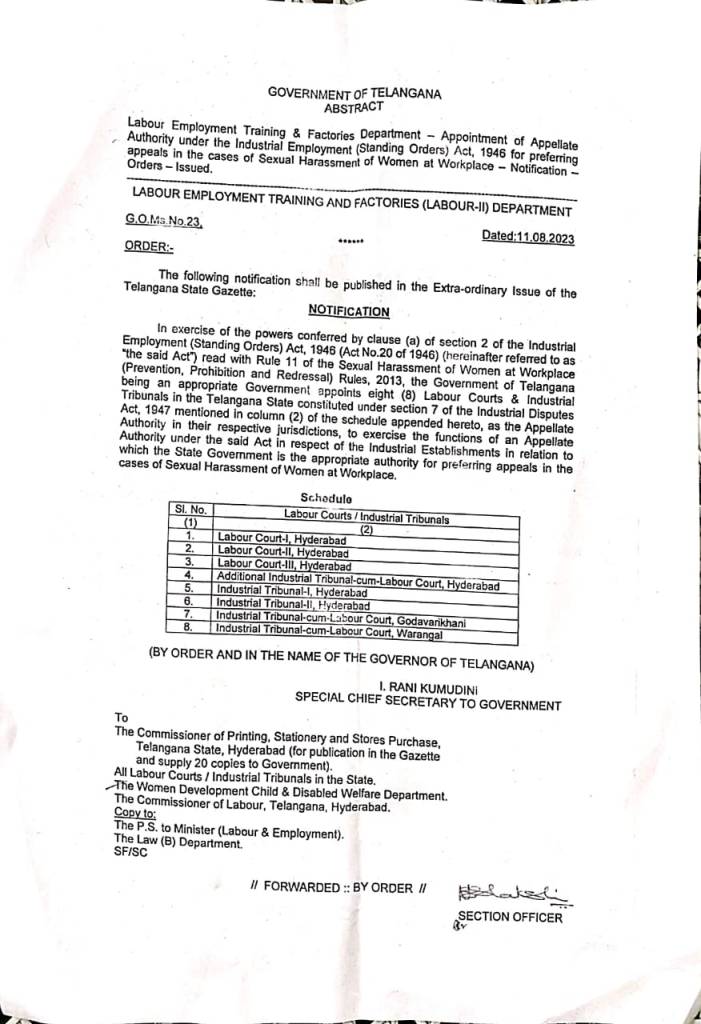
The government of Telangana has constituted an appellate authority under the POSH Act 2013.
The government of Telangana has constituted an appellate authority under the POSH Act 2013.
According to section 18 rule 11 of the Protection of Women from Sexual Harassment Act, 2013 (the POSH Act), the state government has to constitute an appellate authority. However, despite the ten years passed after the enactment of the Act, the Telangana government did not constitute the appellate authority; therefore, the persons who are aggrieved by the inquiry findings and decisions of the Internal Complaints Committee (I.C.C) had no opportunity to appeal against the orders.
One of the petitioners in the high court who was aggrieved by the orders of the internal complaints committee (I.C.C) because of the biased attitude of the I.C.C violation of due procedures and violation of principles of the natural justice has approached the Department of Labour seeking details of the appellant authority. To his surprise, they came to know that no such appellate authority was in existence.
Therefore, he approached the Hon’ble High Court of Telangana on 03/07/2023 vide W.P. No 17143/2023, praying the court to direct the Government to constitute appellate authority as prescribed under section 18 rule 11 of the POSH act, which enables the complainant or the respondent, whoever aggrieved by the decision of ICC can approach appellate authority.
The High Court directed the Advocate General to appear in this case twice. One of the special Government pleaders appeared and informed the court that the appellate authority was constituted after filing the writ petition vide G.O.Ms No 23 dated 11/08/2023 Department of Labour Employment of Training and Factories ( Labour-II).
Now onwards, persons aggrieved by the enquiry findings and decisions of the Internal Complaint Committee (ICC) can approach the appellate authorities constituted by the Department of Labour Government of Telangana. A copy of the G.O.Ms No 23 dated 11/08/2023 Department of Labour Employment of Training and Factories ( Labour-II) is enclosed.
Case Title: Gummadavelly Rajasekhar vs. State of Telangana.
Case Number: W.P. No. 17143/2023
Advocates: Senior counsel V. Raghunath, Advocate U.D.Jai Bhim Rao, M A Shakeel
Advocates on Record Dr. B. Karthik Navayan, Nalamasa Krishna, Srikanth Chintala and Swapna Gumpula.
LETTER PETITION REQUESTING TO TAKE IT UP AS PUBLIC INTEREST LITIGATION SEEKING A DIRECTION FROM HON’BLE SUPREME COURT OF INDIA TO STOP ISSUING 41-A NOTICE TO THE ACCUSED WHO ALLEGEDLY COMMITTED OFFENCES UNDER SCHEDULED CASTES AND SCHEDULED TRIBES PREVENTION OF ATROCITIES ACT – 1989 AS AMENDED 2015
Hyderabad
To, THE HON’BLE CHIEF JUSTICE OF INDIAN SUPREME COURT OF INDIA TILAK MARG, NEW DELHI-110001, EMAIL – supremecourt@nic.in, justice.dychandrachud@sci.nic.in
PLEASE FIND ATTACHED THE SIGNED AND SCANNED LETTER PETITION IN PFR FORMAT, ALONG WITH MATERIAL PAPERS.
LETTER PETITION REQUESTING TO TAKE IT UP AS PUBLIC INTEREST LITIGATION SEEKING A DIRECTION FROM HON’BLE SUPREME COURT OF INDIA TO STOP ISSUING 41-A NOTICE TO THE ACCUSED WHO ALLEGEDLY COMMITTED OFFENCES UNDER SCHEDULED CASTES AND SCHEDULED TRIBES PREVENTION OF ATROCITIES ACT – 1989 AS AMENDED 2015
INDEX
| Sl No. | Exhibits | Description of Document | Date of Document | Page No.
|
| 1. | – | Letter Petition | 12/08/2023 |
|
| 2. | P1 | Copy of the order of the High Court of Madhya Pradesh in Cr.A. No. 702 of 2020 directing the Police to issue 41-A CrPC Notice to the accused who allegedly committed offences under SC ST POA | 27/01/2020 |
|
| 3. | P2 | Copy of the order of the High Court of Allahabad in Misc Case No. 22306 of 2020 directing the Police to issue 41-A CrPC Notice to the accused who allegedly committed offences under SC ST POA | 25/11/2020 |
|
| 4. | P3 | Copy the order of the High Court of Telangana in CRLP 10674 of 2022 directing the Police to issue 41-A CrPC Notice to the accused who allegedly committed offences under SC ST POA SC ST POA | 01/12/2022 |
|
| 5. | P4 | Copy the order of the High Court of Telangana in CRLP No. 5429 of 2023 directing the Police to issue 41-A CrPC Notice to the accused who allegedly committed offences under SC ST POA SC ST POA | 21/06/2023 |
|
| 6 | P5 | Copy of the circular issued by Addl Director General of Police Rajasthan along with a translation into English. | 29/05/2020 |
|
Subject: Request to Direct the Home Ministries/ Police Departments of the State governments, High Courts and District Judiciary not to issue or entertain the applications for giving 41-A CRPC notice to the accused who allegedly committed offences under the provisions of the Scheduled Castes and Scheduled Tribes (Prevention of Atrocities) Act 1989 (The Act herein)
Respected Hon’ble Chief Justice of India and his companion judges of the Hon’ble Supreme Court of India,
1. It is submitted that the registration of FIRs under the provisions of the Scheduled Castes and Scheduled Tribes (Prevention of Atrocities) Act 1989 has become a challenging task as the victims of the atrocities are not believed by the police administration. In some cases where the Police are forced to register the FIRs through court orders or by public pressure, the Police have entirely stopped arresting the accused and issuing the notices under Section 41-A of Cr.P.C. The accused are misusing their liberty after receiving the notices under Section 41-A Cr.P.C. to terrorise the victims and to prevent proper investigation.
2. It is submitted that the accused are approaching the various High Courts by filing Criminal Petitions under section 482/438 of Cr. P.C. The Hon’ble High Courts are passing orders directing the Police to issue notices under Section 41-A of Cr.P.C. and follow the guidelines of the Supreme Court in Arnesh Kumar Vs State of Bihar(AIR 2014 SC 2756) even in cases where there is a prima facie case against the Accused under the provisions of Scheduled Castes and Scheduled Tribes (Prevention of Atrocities) Act 1989 were made out.
DETAILS OF SOME OF THE ORDERS PASSED BY THE HIGH COURTS DIRECTING THE POLICE TO ISSUE 41-A CRPC TO THE ACCUSED WHO ALLEGEDLY COMMITTED OFFENCES UDNER SC AND ST (POA)
3. It is submitted that the High Court of Madhya Pradesh passed an order in Cr.A. No. 702 of 2020, dated 27/01/2020, directed the Police to issue 41-A CrPC Notice to the accused who allegedly committed offences under SC ST POA. A copy of the order is enclosed for the kind perusal of this Hon’ble Court.
4. It is submitted that the High Court of Allahabad passed an order in Misc Case No. 22306 of 2020 dated 25/11/2020 directing the Police to issue 41-A CrPC Notice to the accused who allegedly committed offences under SC ST POA. A copy of the order is enclosed for the kind perusal of this Hon’ble Court.
5. It is submitted that the High Court of Telangana in CRLP 10674 of 2022 dated 01/12/2022 passed an order directing the Police to issue 41-A CrPC Notice to the accused who allegedly committed offences under SC ST POA. A copy of the order is enclosed for the kind perusal of this Hon’ble Court.
6. It is submitted that the High Court of Telangana in CRLP no. 5429 of 2023 dated 21/06/2023 passed an order directing the Police to issue 41-A CrPC Notice to the accused who allegedly committed offences under SC ST POA. A copy of the order is enclosed for the kind perusal of this Hon’ble Court.
7. It is submitted that the High Courts pass the orders mentioned above without hearing the victims/ complainants; therefore, they are illegal, untenable and in violation of provisions of the S.C. and S.C. (PoA.) and in violation of the rights of the victims of atrocities.
8. It is submitted that in the scenario mentioned above, the Addl Director General of Police Rajasthan has issued a circular dated 25/09/2020 stating that the 41-a Cr. P.C. is not applicable for the offences under sections of SC ST POA . a Copy of the circular along with translation is enclosed for the kind perusal of this Hon’ble court.
9. It is further submitted that the decision of the Supreme Court in Arnesh Kumar Vs. The State of Bihar does not apply to the cases registered under the provisions of Scheduled Castes and Scheduled Tribes (Prevention of Atrocities) Act 1989 as amended by SC ST(POA) Amendment Act 2015 in as much as the very object of Sections 15A (3) and 15A (5) and Section 18 of Scheduled Castes and Scheduled Tribes (Prevention of Atrocities) Act 1989 would be defeated.
10. It is further submitted that the Hon’ble Supreme Court in Union of India vs State of Maharashtra (2018) did not reference the decision in Arnesh Kumar Vs. State of Bihar. On the other hand, the Hon’ble Supreme Court clearly mentioned that the bar created under Section 18 on the grant of anticipatory bail does not attract if a prima facie case is not made out attracting the provisions of Scheduled Castes and Scheduled Tribes (Prevention of Atrocities) Act 1989 and that Section 482 Cr.P.C. can be invoked for quashing the FIR.
11. It is submitted that in many cases, the police officers are issuing notices under Section 41-A Cr.P.C. to the accused who allegedly committed offences under Scheduled Castes and Scheduled Tribes (Prevention of Atrocities) Act 1989, which is against the law and violative of Section 18 of the Scheduled Castes and Scheduled Tribes (Prevention of Atrocities) Act 1989 and against the spirit of the Act.
12. It is submitted that the High Courts have erred in passing the orders directing the Police to issue notices under Section 41-A Cr.P.C. in the cases registered under the provisions of the Scheduled Castes and Scheduled Tribes (Prevention of Atrocities) Act 1989.
13. It is submitted that the Scheduled Castes and Scheduled Tribes (Prevention of Atrocities) Act 1989 is a special enactment, and Section 41-A Cr.P.C. does not apply to the offences registered under the special enactment in as much as special Law prevails over the general Law. As such, issuing the notices under Section 41-A Cr.P.C. to the accused who allegedly committed offences under the provisions of Scheduled Castes and Scheduled Tribes (Prevention of Atrocities) Act 1989 also violates section 18 of the Act, which bars the pre-arrest bail. Further issuing 41-A Cr.P.C. Notices without arresting the accused is equal to granting anticipatory bail, which is barred under section 18 of the Scheduled Castes and Scheduled Tribes (Prevention of Atrocities) Act 1989.
14. It is submitted that section 18 of Scheduled Castes and Scheduled Tribes (Prevention of Atrocities) Act 1989 reads, “Section 438 of the Code not to apply to persons committing an offence under the Act. —Nothing in Section 438 of the Code shall apply in relation to any case involving the arrest of any person on an accusation of having committed an offence under this Act”.
15. It is submitted that in spite of the bar under Section 18 Scheduled Castes and Scheduled Tribes (Prevention of Atrocities) Act 1989 on the grant of anticipatory bail, the High Courts are entertaining applications under Section 438 Cr.P.C. even in cases where there is prima facie case against the accused made out for the offences under the provisions of Scheduled Castes and Scheduled Tribes (Prevention of Atrocities) Act 1989.
16. It is submitted that the orders of the High Courts are against the spirit of the SC ST (POA) Act 1989 and violative of Sections 18 and 15-A of the Scheduled Castes and Scheduled Tribes (Prevention of Atrocities) Act 1989. Therefore, such High Court orders are illegal and liable to be set aside.
17. It is submitted that to protect the victims and witnesses, Section 15A of the Act confers comprehensive rights and imposes obligations on the State for their protection. Section 15A (3) reads, “A victim or his dependent shall have the right to reasonable, accurate, and timely notice of any Court proceeding including any bail proceeding and the Special Public Prosecutor or the State Government shall inform the victim about any proceedings under this Act”. And Section 15A(5) reads as “A victim or hid dependent shall be entitled to be heard at any proceeding under this Act in respect of bail, discharge, release, parole, conviction or sentence of an accused or any connected proceedings or arguments and file written submission on conviction, acquittal or sentencing”.
18. It is submitted that Sub Sections 3 and 5 of Section 15A of Scheduled Castes and Scheduled Tribes (Prevention of Atrocities) Act 1989 are mandatory in nature as per the decision of Supreme Court in Hariram Bambi vs Satyanarayana and another of the Supreme Court, 2021.
19. It is submitted that Section 18 of the Act states that anticipatory bail shall not be allowed to a person accused under the Act. Therefore, the non-arrest of a person charged under the provisions of the Scheduled Castes and Scheduled Tribes (Prevention of Atrocities) Act 1989, which bars anticipatory bail, makes a mockery of the provision.
20. It is submitted that Section 20 of the SC ST (POA) Act 1989 reads as, (An act to override other laws).”—Save as otherwise provided in this Act, the provisions of this Act shall have effect notwithstanding anything inconsistent therewith contained in any other law for the time being in force or any custom or usage or any instrument having effect by virtue of any such law”.
21. It is submitted that Section 41-A of Cr.P.C. contradicts and weakens Section 21 of the Act, which compels the state government to take necessary measures to implement the Act effectively. Thus, giving an accused the benefit of Section 41-A renders these provisions ineffective and leads to a miscarriage of justice.
22. It is submitted that Section 41-A of Cr.P.C. defeats the very object of the Scheduled Castes and Scheduled Tribes (Prevention of Atrocities) Act 1989 and the reasons for enacting the said Act. Preventing the application of Section 41-A Cr.P.C. does not make the arrest arbitrary and mandatory. Instead, it seeks due compliance with the conditions under Section 41 of the Cr.P.C. so that the objectives of the Act may be fulfilled. It strikes at the root of the prevalent dominance of the so-called upper caste and the consequent misuse of liberty by the persons who are alleged to have committed offences under the Scheduled Castes and Scheduled Tribes (Prevention of Atrocities) Act 1989 while on bail to terrorise the victims and to prevent proper investigation.
23. It is submitted that since the Police are not arresting the accused under the Act, the accused terrorise the victims, prevent the proper investigation, and threaten them to withdraw their cases, thereby hampering the administration of justice. As the so-called upper caste people enjoy a relatively better socio-economic status, it becomes easier for an accused to abuse power. Such incidents are frequently reported.
24. It is submitted that it has become a common feature for the accused alleged to have committed offences under the provisions of Scheduled Castes and Scheduled Tribes (Prevention of Atrocities) Act 1989 to file counter cases against the victims and to force them to withdraw the cases filed by them. The Police, under the influence of the accused persons, mostly register false cases against the victims for the offences like 354, 354-A, 354-D IPC.
Therefore, given the facts and circumstances and the settled legal position, it is prayed this Hon’ble Supreme Court of India may be pleased to Direct the Home Ministries of the State governments, High Courts and District Judiciary not to issue or entertain the applications for issuing 41-A Cr.P.C. notices to the accused alleged to have committed the offences under the provisions of Scheduled Castes and Scheduled Tribes (Prevention of Atrocities) Act 1989 in the interest of justice and render justice.
Dr. B Karthik NavayanHuman Rights Activist and Advocate High Court for the State of Telangana at Hyderabad
LETTER PETITION REQUESTING TO TAKE IT UP AS PUBLIC INTEREST LITIGATION SEEKING A DIRECTION FROM HON’BLE SUPREME COURT OF INDIA TO STOP ISSUING 41-A NOTICE TO THE ACCUSED WHO ALLEGEDLY COMMITTED OFFENCES UNDER SCHEDULED CASTES AND SCHEDULED TRIBES PREVENTION OF ATROCITIES ACT – 1989 AS AMENDED 2015
| DR. B. KARTHIK NAVAYAN Office of M.A SHAKEEL U. D. Jai Bhima Rao, Srikanth Chintala, Nallamasu Krishna, Swapna Gumpula, Advocates |
12/08/2023
Hyderabad
To,
THE HON’BLE CHIEF JUSTICE OF INDIA
SUPREME COURT OF INDIA TILAK MARG,
NEW DELHI-110001, EMAIL – supremecourt@nic.in
LETTER PETITION REQUESTING TO TAKE IT UP AS PUBLIC INTEREST LITIGATION SEEKING A DIRECTION FROM HON’BLE SUPREME COURT OF INDIA TO STOP ISSUING 41-A NOTICE TO THE ACCUSED WHO ALLEGEDLY COMMITTED OFFENCES UNDER SCHEDULED CASTES AND SCHEDULED TRIBES PREVENTION OF ATROCITIES ACT – 1989 AS AMENDED 2015
INDEX
| Sl No. | Exhibits | Description of Document | Date of Document | Page No. |
| 1. | – | Letter Petition | 12/08/2023 | |
| 2. | P1 | Copy of the order of the High Court of Madhya Pradesh in Cr.A. No. 702 of 2020 directing the Police to issue 41-A CrPC Notice to the accused who allegedly committed offences under SC ST POA | 27/01/2020 | |
| 3. | P2 | Copy of the order of the High Court of Allahabad in Misc Case No. 22306 of 2020 directing the Police to issue 41-A CrPC Notice to the accused who allegedly committed offences under SC ST POA | 25/11/2020 | |
| 4. | P3 | Copy the order of the High Court of Telangana in CRLP 10674 of 2022 directing the Police to issue 41-A CrPC Notice to the accused who allegedly committed offences under SC ST POA SC ST POA | 01/12/2022 | |
| 5. | P4 | Copy the order of the High Court of Telangana in CRLP No. 5429 of 2023 directing the Police to issue 41-A CrPC Notice to the accused who allegedly committed offences under SC ST POA SC ST POA | 21/06/2023 | |
| 6 | P5 | Copy of the circular issued by Addl Director General of Police Rajasthan along with a translation into English. | 29/05/2020 |
Subject: Request to Direct the Home Ministries/ Police Departments of the State governments, High Courts and District Judiciary not to issue or entertain the applications for giving 41-A CRPC notice to the accused who allegedly committed offences under the provisions of the Scheduled Castes and Scheduled Tribes (Prevention of Atrocities) Act 1989 (The Act herein)
Respected Hon’ble Chief Justice of India and his companion judges of the Hon’ble Supreme Court of India,
- It is submitted that the registration of FIRs under the provisions of the Scheduled Castes and Scheduled Tribes (Prevention of Atrocities) Act 1989 has become a challenging task as the victims of the atrocities are not believed by the police administration. In some cases where the Police are forced to register the FIRs through court orders or by public pressure, the Police have entirely stopped arresting the accused and issuing the notices under Section 41-A of Cr.P.C. The accused are misusing their liberty after receiving the notices under Section 41-A Cr.P.C. to terrorise the victims and to prevent proper investigation.
- It is submitted that the accused are approaching the various High Courts by filing Criminal Petitions under section 482/438 of Cr. P.C. The Hon’ble High Courts are passing orders directing the Police to issue notices under Section 41-A of Cr.P.C. and follow the guidelines of the Supreme Court in Arnesh Kumar Vs State of Bihar(AIR 2014 SC 2756) even in cases where there is a prima facie case against the Accused under the provisions of Scheduled Castes and Scheduled Tribes (Prevention of Atrocities) Act 1989 were made out.
DETAILS OF SOME OF THE ORDERS PASSED BY THE HIGH COURTS DIRECTING THE POLICE TO ISSUE 41-A CRPC TO THE ACCUSED WHO ALLEGEDLY COMMITTED OFFENCES UDNER SC AND ST (POA)
- It is submitted that the High Court of Madhya Pradesh passed an order in Cr.A. No. 702 of 2020, dated 27/01/2020, directed the Police to issue 41-A CrPC Notice to the accused who allegedly committed offences under SC ST POA. A copy of the order is enclosed for the kind perusal of this Hon’ble Court.
- It is submitted that the High Court of Allahabad passed an order in Misc Case No. 22306 of 2020 dated 25/11/2020 directing the Police to issue 41-A CrPC Notice to the accused who allegedly committed offences under SC ST POA. A copy of the order is enclosed for the kind perusal of this Hon’ble Court.
- It is submitted that the High Court of Telangana in CRLP 10674 of 2022 dated 01/12/2022 passed an order directing the Police to issue 41-A CrPC Notice to the accused who allegedly committed offences under SC ST POA. A copy of the order is enclosed for the kind perusal of this Hon’ble Court.
- It is submitted that the High Court of Telangana in CRLP no. 5429 of 2023 dated 21/06/2023 passed an order directing the Police to issue 41-A CrPC Notice to the accused who allegedly committed offences under SC ST POA. A copy of the order is enclosed for the kind perusal of this Hon’ble Court.
- It is submitted that the High Courts pass the orders mentioned above without hearing the victims/ complainants; therefore, they are illegal, untenable and in violation of provisions of the S.C. and S.C. (PoA.) and in violation of the rights of the victims of atrocities.
- It is submitted that in the scenario mentioned above, the Addl Director General of Police Rajasthan has issued a circular dated 25/09/2020 stating that the 41-a Cr. P.C. is not applicable for the offences under sections of SC ST POA . a Copy of the circular along with translation is enclosed for the kind perusal of this Hon’ble court.
- It is further submitted that the decision of the Supreme Court in Arnesh Kumar Vs. The State of Bihar does not apply to the cases registered under the provisions of Scheduled Castes and Scheduled Tribes (Prevention of Atrocities) Act 1989 as amended by SC ST(POA) Amendment Act 2015 in as much as the very object of Sections 15A (3) and 15A (5) and Section 18 of Scheduled Castes and Scheduled Tribes (Prevention of Atrocities) Act 1989 would be defeated.
- It is further submitted that the Hon’ble Supreme Court in Union of India vs State of Maharashtra (2018) did not reference the decision in Arnesh Kumar Vs. State of Bihar. On the other hand, the Hon’ble Supreme Court clearly mentioned that the bar created under Section 18 on the grant of anticipatory bail does not attract if a prima facie case is not made out attracting the provisions of Scheduled Castes and Scheduled Tribes (Prevention of Atrocities) Act 1989 and that Section 482 Cr.P.C. can be invoked for quashing the FIR.
- It is submitted that in many cases, the police officers are issuing notices under Section 41-A Cr.P.C. to the accused who allegedly committed offences under Scheduled Castes and Scheduled Tribes (Prevention of Atrocities) Act 1989, which is against the law and violative of Section 18 of the Scheduled Castes and Scheduled Tribes (Prevention of Atrocities) Act 1989 and against the spirit of the Act.
- It is submitted that the High Courts have erred in passing the orders directing the Police to issue notices under Section 41-A Cr.P.C. in the cases registered under the provisions of the Scheduled Castes and Scheduled Tribes (Prevention of Atrocities) Act 1989.
- It is submitted that the Scheduled Castes and Scheduled Tribes (Prevention of Atrocities) Act 1989 is a special enactment, and Section 41-A Cr.P.C. does not apply to the offences registered under the special enactment in as much as special Law prevails over the general Law. As such, issuing the notices under Section 41-A Cr.P.C. to the accused who allegedly committed offences under the provisions of Scheduled Castes and Scheduled Tribes (Prevention of Atrocities) Act 1989 also violates section 18 of the Act, which bars the pre-arrest bail. Further issuing 41-A Cr.P.C. Notices without arresting the accused is equal to granting anticipatory bail, which is barred under section 18 of the Scheduled Castes and Scheduled Tribes (Prevention of Atrocities) Act 1989.
- It is submitted that section 18 of Scheduled Castes and Scheduled Tribes (Prevention of Atrocities) Act 1989 reads, “Section 438 of the Code not to apply to persons committing an offence under the Act. —Nothing in Section 438 of the Code shall apply in relation to any case involving the arrest of any person on an accusation of having committed an offence under this Act”.
- It is submitted that in spite of the bar under Section 18 Scheduled Castes and Scheduled Tribes (Prevention of Atrocities) Act 1989 on the grant of anticipatory bail, the High Courts are entertaining applications under Section 438 Cr.P.C. even in cases where there is prima facie case against the accused made out for the offences under the provisions of Scheduled Castes and Scheduled Tribes (Prevention of Atrocities) Act 1989.
- It is submitted that the orders of the High Courts are against the spirit of the SC ST (POA) Act 1989 and violative of Sections 18 and 15-A of the Scheduled Castes and Scheduled Tribes (Prevention of Atrocities) Act 1989. Therefore, such High Court orders are illegal and liable to be set aside.
- It is submitted that to protect the victims and witnesses, Section 15A of the Act confers comprehensive rights and imposes obligations on the State for their protection. Section 15A (3) reads, “A victim or his dependent shall have the right to reasonable, accurate, and timely notice of any Court proceeding including any bail proceeding and the Special Public Prosecutor or the State Government shall inform the victim about any proceedings under this Act”. And Section 15A(5) reads as “A victim or hid dependent shall be entitled to be heard at any proceeding under this Act in respect of bail, discharge, release, parole, conviction or sentence of an accused or any connected proceedings or arguments and file written submission on conviction, acquittal or sentencing”.
- It is submitted that Sub Sections 3 and 5 of Section 15A of Scheduled Castes and Scheduled Tribes (Prevention of Atrocities) Act 1989 are mandatory in nature as per the decision of Supreme Court in Hariram Bambi vs Satyanarayana and another of the Supreme Court, 2021.
- It is submitted that Section 18 of the Act states that anticipatory bail shall not be allowed to a person accused under the Act. Therefore, the non-arrest of a person charged under the provisions of the Scheduled Castes and Scheduled Tribes (Prevention of Atrocities) Act 1989, which bars anticipatory bail, makes a mockery of the provision.
- It is submitted that Section 20 of the SC ST (POA) Act 1989 reads as, (An act to override other laws).”—Save as otherwise provided in this Act, the provisions of this Act shall have effect notwithstanding anything inconsistent therewith contained in any other law for the time being in force or any custom or usage or any instrument having effect by virtue of any such law”.
- It is submitted that Section 41-A of Cr.P.C. contradicts and weakens Section 21 of the Act, which compels the state government to take necessary measures to implement the Act effectively. Thus, giving an accused the benefit of Section 41-A renders these provisions ineffective and leads to a miscarriage of justice.
- It is submitted that Section 41-A of Cr.P.C. defeats the very object of the Scheduled Castes and Scheduled Tribes (Prevention of Atrocities) Act 1989 and the reasons for enacting the said Act. Preventing the application of Section 41-A Cr.P.C. does not make the arrest arbitrary and mandatory. Instead, it seeks due compliance with the conditions under Section 41 of the Cr.P.C. so that the objectives of the Act may be fulfilled. It strikes at the root of the prevalent dominance of the so-called upper caste and the consequent misuse of liberty by the persons who are alleged to have committed offences under the Scheduled Castes and Scheduled Tribes (Prevention of Atrocities) Act 1989 while on bail to terrorise the victims and to prevent proper investigation.
- It is submitted that since the Police are not arresting the accused under the Act, the accused terrorise the victims, prevent the proper investigation, and threaten them to withdraw their cases, thereby hampering the administration of justice. As the so-called upper caste people enjoy a relatively better socio-economic status, it becomes easier for an accused to abuse power. Such incidents are frequently reported.
- It is submitted that it has become a common feature for the accused alleged to have committed offences under the provisions of Scheduled Castes and Scheduled Tribes (Prevention of Atrocities) Act 1989 to file counter cases against the victims and to force them to withdraw the cases filed by them. The Police, under the influence of the accused persons, mostly register false cases against the victims for the offences like 354, 354-A, 354-D IPC.
Therefore, given the facts and circumstances and the settled legal position, it is prayed this Hon’ble Supreme Court of India may be pleased to Direct the Home Ministries of the State governments, High Courts and District Judiciary not to issue or entertain the applications for issuing 41-A Cr.P.C. notices to the accused alleged to have committed the offences under the provisions of Scheduled Castes and Scheduled Tribes (Prevention of Atrocities) Act 1989 in the interest of justice and render justice.
Dr. B Karthik Navayan
Human Rights Activist and Advocate
High Court for the State of Telangana at Hyderabad
Complaint against Cyber Terrorist Hamara Prasad (Phone No. 9177777148) for the politically motivated use of computers and information technology to cause severe disruption or widespread fear in society by abusing Dr B R Ambedkar and forwarding abusive videos internet and social media platforms
10/02/2023
To,
The Station House Officer
Cybercrime Police Station, Hyderabad
Email: sho_cybercrimes@cyb.tspolice.gov.in
The Circle Inspector Cyber Crime Police Station
Hyderabad, Telangana
Email – ci_pcr@cyb.tspolice.gov.in
Copy to:
- The Commissioner of Police Hyderabad Hyderguda-Basheerbagh Rd, Hyderabad, Telangana 500029, Email – cp-hyderabad@tspolice.gov.in, Twitter – @CPHydCity
- The Director and Inspector General of the Police, opposite Ravindra Bharathi, Lakdikapul, Hyderabad, Telangana 500004, Email – dgp@tspolice.gov.in, Twitter – @TelanganaDGP
Subject: Complaint against Cyber Terrorist Hamara Prasad (Phone No. 9177777148) for the politically motivated use of computers and information technology to cause severe disruption or widespread fear in society by abusing Dr B R Ambedkar and forwarding abusive videos internet and social media platforms
Dear sir,
I am Dr B. Karthik Navayan, Occ: Advocate, R/o Hyderabad, belonging to the Scheduled caste community. I am filing this complaint against a cyber-terrorist Hamara Prasad (Phone No. 9177777148), who is creating and forwarding videos abusing Dr B R Ambedkar and hurting the sentiments of the Scheduled Caste citizens.
I received a video on WhatsApp that was forwarded to several groups. The video was created and circulated by a person named Hamara Prasad. The screenshot of the video and link to the video is below.
Screenshot of the video

Link to video – https://twitter.com/Navayan/status/1623742878697783298?s=20&t=TNALcjVMph93wsLjmj-nAg
In the video mentioned above, the person abused Dr B R Ambedkar and said he would have killed Dr B R Ambedkar like Godse killed Gandhi. This action of the alleged accused, Hamara Prasad, hurt the sentiments of citizens of India and the sentiments of the Scheduled castes in particular, as the scheduled castes feel that the Dr B R Ambedkar a sacred
By abusing Dr Ambedkar and using filthy language against the national icon by Hamara Prasad destroys, damages or defiles any object that is generally known to be held sacred or in high esteem by members of the Scheduled Castes or the Scheduled Tribes. It also amounts to cyber terrorism as the alleged accused, Hamara Prasad, is using the computer, internet and social media platforms and information technology to politically motivated cause severe disruption or widespread fear in society.
Therefore, I request your kind self to register an FIR against the accused, Hamara Prasad, a resident of Hyderabad/ Secunderabad and block all his social media handles immediately to stop the circulation of cyberterrorism.
Hamara Prasad’s phone number is 9177777148,
Twitter: @HamaraPrasad
YouTube: https://www.youtube.com/c/HamaraPrasad
Facebook: https://www.facebook.com/profile.php?id=100070606680121
Further, I request you to invoke section 66 F of the Information Tocology Act for (A) with intent to threaten the unity, integrity, security or sovereignty of India or to strike terror and invoke section 153A of IPC for provoking the caste and communal tensions and invoke 3(1) (t) of SC & ST PoA for damages or defiles any object generally known to be held sacred or in high esteem by members of the Scheduled Castes or the Scheduled Tribes.
Further request you to arrest the accused, Hamara Prasad and send him to judicial custody to prevent him from making further harmful videos and circulating them on the interment
Sincerely,
Dr.B. Karthik Navayan
Advocate, Hyderabad
Email – navayan@gmail.com
Phone: 9346677007
Guest Post: Equality as Non-Exclusion: Justice Bhat’s Dissent in the EWS Case
[This is a guest post by Kieran Correia.] The Supreme Court recently handed down a split verdict in Janhit Abhiyan v Union of India, upholding the 103rd Amendment to the Indian Constitution. The Amendment, in the main, enabled affirmative action for economically weaker sections (EWS), defined by an annual family income of less than Rs […]
Guest Post: Equality as Non-Exclusion: Justice Bhat’s Dissent in the EWS Case
 Dr. B Karthik Navayan